Showing posts with label Husserl. Show all posts

Monday, August 25, 2008

The Real Hard Problem (Cont'd)

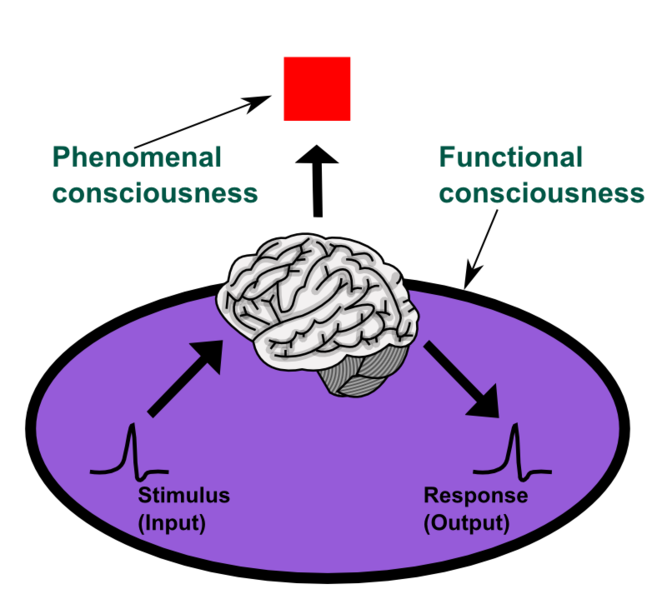
In my last post I argued that Chalmers' distinction between the psychological and the phenomenal concepts of mind misses what is in fact the most peculiar feature about human mindedness, namely, that our psychology is manifest through our phenomenology. Chalmers focuses upon what are in fact aberrant cases of human wakeful consciousness (sensations like pain, or the fact that minor chords are often associated with a dour feeling, or a struck funny bone ) in order to bring out a supposedly general concept, viz., the phenomenal. The phenomenal concept of mind designates that feature of consciousness that, like pain, supervenes upon otherwise psychologically specifiable states. The hard problem in philosophy of mind is too account for this queer property.

Chalmers' phenomenalism is of course very unlike the phenomenalisms characteristic of the early twentieth century. Traditional phenomenalisms focused upon phenomena as the objects or contents of conscious states (usually confusing or conflating the distinction). Chalmers’ notion of the phenomenal is closer to Brentano’s concept of inner consciousness than it is to these theories. Brentano characterized inner consciousness as a sort of second-order awareness that accompanies all conscious acts. Brentano’s inner consciousness—like, presumably, Chalmers phenomenal awareness—is necessarily second order in that is must always accompany an object-directed act (the act’s ‘primary content’). Presumably Chalmers (like Husserl) would disagree that all mental states are intentional, for not all mental states are object-directed or object-consciousness. But this should not affect the secondary status of phenomenal consciousness, so long as we admit that there is no such as ‘pure consciousness’ (mystics to the contrary). Chalmers, Brentano and Husserl would all agree—I think—that in order for phenomenal consciousness to arise, something else must be going on as well, whether that something else is object-directed or not. 

However, from the fact that phenomenally conscious states need not be object-directed (intentional), it does not follow that object-directed states need not be phenomenal. Chalmers makes this unwarranted inference—and is not aytpical in so doing. He does so because, given different definitions of objectivity, there are different ways of accounting for intentionality (computationally, truth-semantically, informatically, etc), but the point is that none of these get at the fact that there are objects--and therefore a world--for us only insofar as we are conscious. This important blindspot has unfortunately eclipsed for many thinkers any true interest in (Husserlian) phenomenology, for lack of understanding the conceptual terrain in which it works. (NB: because of the ambiguities associated with the term phenomenal, I prefer to use the term ‘personal’: what is characteristic about human intentionality, as opposed to say either computer or dog intentionality, is that it is personal). 

What is that terrain? Above I stated that in order for phenomenal consciousness to arise, something else must be going as well (although it need not be object-oriented, contrary to Brentano). Alternatively, as I just argued, in order for there to be object-oriented consciousness for persons, this consciousness must be phenomenal—or better, personal. Notice the modal terms: must be this, must be that. There is a necessity here. Contra Chalmers—as I noted in the last post—the co-occurrence of the phenomenal and psychological in the unity of personal consciousness is not a matter of mere empirical or contingent fact, but one of necessity. The question is, what sort? 

Brentano observed that mental phenomena are characterized by a certain unity unlike that exhibited by physical phenomena. Mental phenomena—all the various contents of any given moment of consciousness—are unified internally, rather than externally; unlike the co-occurrence of physical phenomena, mental phenomena do not just happen to be next to each other (successive in Hume’s sense). This unity is supplied by the fact that all mental contents of a momentary act of consciousness are unified in one consciousness. The various contents and objects of a momentary act of consciousness (the 'specious present') don't just happen to be in the same 'place' in the way that the books and bed and desk I own just happen to be in this room with me now. The unity that underlies the contents of consciousness is tighter and more rigorous than the merely spatial co-location of items in my room. (This is of course an old point, going back at least to Kant, even Leibniz). Hume’s mistake, according to Brentano, was to believe that since there was no simple, detectable entity underlying the various presentations, there was no self. Mental phenomena do not appear to (in the dative) a self; the self is the unity of mental phenomena in one consciousness. Hume’s mistake was to confuse unity with simplicity, and Kant’s mistake was to confuse the appearance of external, material objects to a self with the presentation of a self’s own mental acts to itself (in a secondary, rather than dative manner, as discussed above).

We therefore need a way to talk about the unity of consciousness and mental phenomena—the unity of the phenomenal and the psychological in the personal—in a way that does not presuppose that his unity is a contingent matter of fact. That is to say, the unity involved here is of a logical or conceptual, rather than factual, sort. Brentano began the application of mereological concepts to the philosophy of mind, Husserl then formalized and extended this notion, putting it at the heart of his systematic phenomenology. When I claim, as I often have before, that phenomenology is a sort of formal science, it is this that I have in mind. 

A final coda: What about the fact that many aspects and ‘contents’ of conscious life seem to go unnoticed, and in that sense, are impersonal? In other words, how do Brentano and Husserl avoid the imputation that their respective sciences are introspectionist (which, by the way, both deny)?  Many have taken the results of phenomena such as change-blindness, attentional-blindness, blindsight, etc., to argue for the presence of non-conscious but nonetheless intentional contents of consciousness as a decisive refutation of the phenomenological method. While I won't go into details here, this attack is levied against a straw-man: neither Brentano nor Husserl have argued that the contents of mental phenomena were simply there waiting to be observed. Again, the argument relies upon the mereological theory of mind. Take the experience of a chord. As tone-stupid as they come, I could not begin to pull out the separate notes of any given chord. Are those separate notes present in my consciousness? Dennett takes this as proof that there are no qualia, and therefore that only heterophenomenology will be able to describe the real contents of my consciousness. Brentano takes a different line: those notes are there, but as mereological parts of the whole chord as a phenomena of consciousness. They are there, because I hear the whole chord, but they are not explicit objects of my attentional consciousness. More importantly, the whole chord is there, not as a sum of those notes, but again, as the whole that is mereologically prior to those parts. Husserl’s own phenomenology departs precisely from here, and this notion of the whole that is prior to its part is precisely what Husserl means by ‘synthetic.’ 

Continue Reading...

Friday, August 22, 2008

The Real Hard Problem

The hardest thing in philosophy is coming up with a genuinely hard problem. The most impressive thing for a philosopher to accomplish is to come up with a genuine hard problem and to articulate it in a very clear way. By these criteria, there is no doubt that Chalmers has accomplished something impressive through his notion of the ‘hard problem’ in philosophy of mind. With this sincere kudo out of the way, let me make forth with a reservation. I’m not completely sold on Chalmer’s distinction between the phenomenal and the psychological, and not being sold on this, I wonder if he really has picked out a genuine hard problem. No doubt the problem he has articulated is genuinely hard, I’m just not convinced that it’s a genuine problem.


Chalmers opens The Conscious Mind (all citations below are to this edition) by insisting that two concepts of mind exhaust all there is to say about mindedness: these are the phenomenal and the psychological. The psychological concept of mind encompasses a broad definition of the field of cognitive psychology, and as such, is primarily oriented toward explainnig the behavior of minded organisms in terms of inner processes or mechanisms—such mechanisms might be striclty neurological, computational, connectionist, informatic or even Freudian (and by the way, don’t worry about meaning of ‘inner.). The phenomenal concept of mind Chalmers approvingly defines through Nagel’s ‘something that it is like to be that [minded] organism,’ a unique property I like to call ‘what-it’s-like-ity.’ Chalmers points out that this sort of property will only allow ostensive definition, and typically can be pointed out only through its association with publicly recognized psychological states. Because of this, there is is always a danger to conflate the pychological and the phenomenal, and while this is fine for most everyday contexts, in science and philosophy especially we must always be mindful of the distinction.

“…for philosophical purposes and in particular for the purposes of explanation, to conflate the two properties is fatal.” (23)

Minding this conflation, Chalmers famously argues, gives rise to a division of labor among philosophers of mind, whereby the psychological matters, while extraordinarily complex, are in principle solvable. In Chalmers words, psychological issues pose immense technical difficulties, but no real metaphysical ones (this claim I suspect is too cavalier, but I’ll not make anything of that here). But because the phenomenal character of consciousness fails to fit into any acceptable current scientific or philosophical framework (since dualism is ruled out of court), it is this feature that poses the truly ‘hard problem’ in philosophy of mind.

So, what then is this phenomenal property, exactly? Again, Chalmers doubts, at least within any existing conceptual repitoire, that anything other than an ostensive definition associated with recognized psychological states will be possible. He chooses pain as an exemplary case. A roughly acceptable definition of pain can be given in psychological (i.e. functional) terms, but this leaves out the phenomenal feature of pain that, in the end, makes pain matter so much to us. Pain is exemplaroy here in that this fact is common to all sorts of mental concepts, viz. a phenomenal property supervenes on a psychological one but does not seem to be essential to that psychological property qua psychological. One is tempted to say that this what-it’s-like-ity is a sort of sensation, except that it is that very feature whereby a sensation (like any other mental phenomena) becomes a sensation. At the very least, it seems to be a rather logically simple, discrete and ethereal property, one that is incidental to the psychological state underlying it (indeed, this is the whole rub).

Does intentionality fit into any of this? Chalmers is confident that intentionality (and therefore the theory of intentionality) belongs on the psychological side of the divide. Chalmers—typical of most of the anglophone literature on the matter—defines intentionality through the notion of a propositional attitude, and therefore accepts the semantic concept of intentionality. On this semantic conception, to be in an intentional state is to adopt a sort a sort of attitude towards a propositional-like structure (a belief, typically). And since it seems that a plausibly psychological notion of belief is available (something like: ‘a belief is a doxic attitude towards a state whereby one’s behavior would be appropriate in a situtation if that proposition were in fact true, and such that this state is normally brought about when that proposition is in fact true’), we can quibble about whether some phenomenal state is also essentially involved with intentional states, but it’s probably not worth the bother (see pp19-20).

This is where I would like to register my reservations. Chalmers wants to argue that the phenomenal and the psychological come together merely contingently, as a matter of empirical fact, but not essentially. This seems wrong to me. He can say things like this because he chooses phenomena like pain, or hearing middle-C, or the sensation of red, as his examples, but these sorts of ‘raw feel’ examples, and pain especially, are very untypical phenomenal states. For the most part, the world is revealed to us through our phenomenal states, and the separation between the phenomenal and the psychological that Chalmers insists upon is rather the exception than the rule. In other words, for humans at least, phenomenal states have the peculiarity of being intentional, ie., they reveal objects therefore are world-disclosing. Thus the phenomenal and the psychological come together, not as merely concurring phenomena, not as a mere matter of fact, but through some sort of necessity.

What is actually peculiar about the phenomenal feature of human consciousness is that it is intentional, which is to say, that it is by virtue of our phenomenal consciousness that we are aware of an objective world. Now, this introduces the heady problem of what to count as consciousness of an objective world, and therefore, of how to understand ‘objectivity,’, but this problem—I want to stress—is a formal or logical problem, and not primarily, maybe even not at all, a scientific one, and it is certainly not a problem that Chalmers has cared to recognize. Moreover, I believe that this is a legitimately hard problem, but unlike Chalmers own hard problem, we at least have some respectable ways to think through it.

I am arguing that, contra Chalmers, the psychological and the phenomenal are not together as a matter of mere empirical fact, but through a sort of logical necessity. When we speak about this essential unity of the psychological and the phenomenal, we are speaking about intentionality. In a follow-up post, I will say more about what this sort of logical necessity is (spoiler: it’s mereological), so I want to finish with just this observation. I do not doubt that as a matter of fact we will someday be able to construct complex systems that are genuinely psychological in the sense relevant to Chalmers. That is, we will construct systems that will, without speaking merely metaphorically, learn, memorize, process information, believe, perceive, and so on. And I also do not doubt that there are plenty such beings alive on earth already, viz., all the more complex mammals and fish and reptiles (I have my doubts about them amphibians). Nor do I doubt that animals have a phenomenal consciousness, again in Chalmers sense. But from the fact that we can both conceptually and in reality separate these two aspects does not in any way require that their concurrence in human consciousness is itself also merely factual or contingent. This would be like reasoning from the fact that, since some organic visual systems do not detect color, that color is merely incidental to normal human vision, a fact that merely supervenes upon visual psychology. But that’s not right. Normal human vision is intrinsically, not accidentally, colorful.


Continue Reading...

Tuesday, August 5, 2008

Phenomenology Revisited?

Last week Leiter linked favorably to a review essay on D.W. Smith’s Husserl by Sean Kelly. Kelly portrays Smith’s new book as further evidence that phenomenology is gaining credibility among main-stream analytic thinkers. Kelly himself of course has not been incidental to this development.

I’m all for the tone of this pep rally, but I might register some reservations about the message. Kelly suggests that the new (or renewed) interest in phenomenology among anglophone philosophers should thank in large part the pluralization of analytic philosophy itself. It’s as if analytic philosophy were sagging under its own weight, to the point where finally it’s either necessary or safe for anglophone thinkers to search out non-orthodox and non-canoncial sources in order to avoid theoretical suffocation. (For my part, I hope this isn’t just the result of a cohort of publishers all competing for some weird reason to get the ‘standard’ Husserl book out there.)

I’m not sure if that is right, but it sounds plausible (not that analytic philosophy has collapsed, but that the traditiontional project of analysis has—long ago—and that more recently it’s increasingly safe for ordinary philosophers to peruse a volume or two of Husserl, or even Heidegger).

But this version of things almost makes the return of phenomenology seem accidental, as if analytic philosophers simply grabbed for the nearest thing. At the very least, it neglects the fact that there were islands of phenomenology that survived the Great Deluge of post-structuralism and post-existentialism, populated with thinkers like Roderick Chisholm, Dagfinn Follesdal, Jaako Hintikka, Hubert Dreyfus and D. Smith himself. By the 1980’s, there was a dedicated group of Husserl and Merleau-Ponty scholars who were cris-crossing both fields and had the language and concepts ready for when interest finally did turn their way. (Lots of other thinkers I’m forgetting, but this is just a quick post—I’ll maybe update later).

In any case, instead of historiography, I’d like to focus on two issues raised by Kelly in the review, one positive, and one negative, both complementary. First, the negative. Kelly is among those who are impressed that analytic philosophers have finally discovered that we humans are minded, and not just linguistic, creatures. This is where the turn to phenomenology seems fortuitous. Anglophone philosophy has realized that subjective, first-person experience is an actual problem and issue, and then lo, here is a tradition nearly a century old with literally thousands and thousands of pages on the subject. A match is made.

But, if the renewed interest in phenomenology just comes down the fact that Husserl had gotten things like stereoscopic vision correct many decades before mainstream analytic philosophy, this is going to be a brief affair. To be sure, anyone would benefit from a good reading of Husserl’s analyses of internal time consciousness, but there are other reasons why phenomenology is interesting besides it’s field analyses. So, I’m taking issue with Kelly’s claim that

“the real contribution of Husserl's work is not systematic (though Husserl himself certainly had systematic ambitions); it lies rather in the careful and detailed analyses he provides of an enormous range of philosophical domains.”

If this is so, then I’m afraid that there is no real turn to phenomenology (or Husserl) in the first place. I mean, to discover something independently (say, that vision is stereoscopic, or that perception is inter-modal, or that subjective time is not in any easily determinate way a mere representation of objective time), to then discover that Husserl had some said something similar much earlier, and then to pat Husserl on the back for his prescience, is, while at least giving credit where credit is due, hardly a return to Husserl or phenomenology in general. (This is typically how these things have gone). At best, what this should suggest is that, if Husserl had gotten that right, then maybe he had other things right, and should be given a closer, second (or third, or nth) look. But I don’t see as much evidence of that happening. So, my negative point to make about Kelly’s review is his idea that phenomenology has much to contribute to contemporary philosophy of mind just because phenomenology was interested in first-person experience. This is unlikely. The danger here is that phenomenology simply becomes mis-identified as any careful scrutiny of experience from a first-person point of view, when, number one, it is not that, and number two, even if it were that is hardly its main point of interest. (And by the way, while this may be true to some extent for Husserl, how could Heidegger be read this way, as focused on first-person, subjective experience—isn’t Heidegger’s whole point to get away from this way of thinking about human being as mindedness as representations as subjective perception?)

Finally, Kelly is I’m afraid punching a bit of a straw man when it comes to analytic philosophy. As he would have it, analytic philosophy is simply the idea that all problems of philosophy are problems of langauge. But it is a bit unfair to put the idea that baldly; there was a keen insight there, which is that much of the time we simply are not clear on what exactly it is that we are asking, and by focusing on the way that we express our problems we can better focus of what is really at issue. Just as (among the giants at least) continental philosophy is rarely as disappointing as its caricature, the same is true of analytic philosophy.

But now to the positive point: Kelly does, in my estimation, correctly emphasize the unique role of description in the phenomeonlogical project, especially its uniquenes as method of inquiry to be distinguished from transcendental argumentation, deduction, empirical generalization, and so on. He does not emphasize this, but I want to. For instance, Kelly mentions that Husserl had, years before Searle, emphasized that even our run-of-the-mill perceptions of run-of-the-mill objects rely upon a ‘horizon’ or ‘background,’ a certain context. What are we to make of this horizon? Russell, as Kelly notes, had tried to make sense of it in terms of beliefs, but that is not adequate. I can see the barn façade as pointing to a backside even if I do not believe that there is a backside (Kelly’s example). Can it be explained in terms of ‘information,’ as defined by information theory? Or a set of background, pragmatic practices? Not sure, but in any case, what phenomenology at its best tries to uncover is the ‘true’ nature of experience prior to all theorizing or modelling. This may be a hopeless task, but it is the task on which phenomenology rests. It is the premise behind the descriptive method.

Finally, I would say that there is still something else important about phenomenology that Kelly does not get to. I would call the sort of ‘phenomenology’ that interests Kelly ‘phenomenology in the natural attitude.’ That is to say, he and others like him are doing phenomenology in the sense that they are striving for concepts and methods that will let us really and genuinely get at what it is like to have normal, quotidian experience. (As opposed to, say, sense-data theories that badly distort what everyday experience is like). This is a laudable and, I might venture, achievable goal. It is shared by thinkers like Alva Noë, Andy Clark and Shaun Gallagher. These thinkers are not interested per se in the epistemological projects that motivated, say, Husserl. But I think that this attitude can lend to a distortion of Husserl’s project as well. For instance, although he doesn’t put it in just this way, Kelly almost makes it seem as if Husserl’s method of reduction is intended to get at the precisely the field of experience that interests him, Kelly. But that is hardly correct. The reductions, obviously enough, have the express intention of getting the phenomenologist out of the natural attitude. And why? Because of the epistemological work Husserl hopes that opening up the phenomenological field will get right. That is to say, Husserl is not interested in just accurately describing everyday quotidian experience. He wants to understand how our knowledge about, say, arithmetic, arises out of this sort of experience. And this, for example, should be of interest to empiricists. If, for instance, what was really wrong with the early project of logical empiricism was not its logical or epistemological apparatus, but the combination and foundation of that apparatus upon a faulty and ‘phenomenologically’ inept concept of experience, perhaps a better, more sophisticated concept would save the intitial project. I think that John McDowell, for example, is doing something like this, and it just takes a brief moment of comparison to see how similar McDowell and Husserl are despite the fact that McDowell shows almost no interest in phenomenology per se (compare for example McDowell’s notion of propositionally contentful experience with Husserl’s categorial intuition.)

Alright, I’ve gone on enough, and I’m not sure that this is all coherent, but it’s my first impression on Kelly’s piece. Despite my criticisms, I really hope that Kelly’s optimism is warranted. We will find out I suspect sooner rather than later.

Continue Reading...

Tuesday, June 26, 2007

Are Mental States Intrinsically Intentional?

Discussing the problem of reference in his book on Husserl and Frege, Michael Dummett complains that for Husserl “the intentionality of mental acts was so axiomatic…that he perceived no necessity to demonstrate it in particular cases.” (Origins of Analytic Philosophy, Chapter 6, p55). Thus, whereas Frege developed a sophisticated if flawed theory of saturation in order to account for the meaningfulness of partial or incomplete expressions, Husserl--taking it for granted that any meaningful expression intrinsically enjoyed objective reference--failed even to problematize the issue. Since every thought, including partial thoughts, is intentional, and all intentional states have directness or reference (Bedeutung), there is no need to account for the specific reference of partial acts.

Dummett’s right. Husserl did take it for granted that mental acts are intrinsically and primitively intentional. I’m not going to argue here over whatever implications this might have for a Husserlian theory of reference (although Dummett is wrong that Husserl never saw this as a problem). I would like instead to consider the more fundamental gripe: can we assume that mental states are intrinsically intentional?

On the one hand, it seems obvious that we should. For what would it mean to speak about a belief, or perception, or desire that ignored what that belief, perception or desire were about. If we cannot think of what a belief, perception or desire would be like without it being about something—without it being intentional—then this is probably a good indication that mental states like beliefs, desires and perceptions are intrinsically (even ‘axiomatically’) intentional.

On the other hand, as Putnam points out, there’s a strong whiff of magical thinking somewhere in here. In that great Intro article of lore, “Brains in a Vat,” Putnam asks, suppose that the tracks of an ant happen to spell out WINSTON CHURCHILL, would this mark mean Winston Churchill? Certainly not by itself. But if marks and noises do not meaning anything ‘in themselves,’ what could it be, other than some magical mystery property, about thoughts (or brain states) such that they are intrinsically representational, ie intentional?

Putnam’s answer we know is that no mental state as such is intrinsically representational; there is no way to determine what a state represents simply from of features intrinsic to that state. The famous Twin Earth Gedankenexperiment is directed at precisely this point. What matters rather is how that state stands vis-à-vis its environment, and specifically, the causal lineage of that state in terms of its environment.

McDowell I think has an interesting response to this, one which, if plausible, lends support to Husserl. In “Putnam on Mind and Meaning,” McDowell argues that Putnam is led to deny an intrinsic intentionality to mental states because he sticks to a false dilemma regarding the following two claims: a) to know what a mental state means (represents) is wholly a matter of knowing about the subject’s mind; and b) that meaning determines extension. Since, as the Twin Earth Gedankenexperiment shows, two subject’s can be qualitatively indistinguishable by what we know from (a) but differ according to (b), Putnam thinks that we are forced to abandon (a) if we want to retain (b).

However, this is only because of Putnam’s unstated commitment to a psychologically “narrow” interpretation of (a), that is, the idea that a mental state...
“must in itself consist in the presence in the mind of an item with an intrinsic nature characterizable independently of considering what it represents.”
Now, as McDowell emphasizes, this surely is a phenomenologically inaccurate rendering of what it means to be in a particular mental state. For it simply is not the case that, when I reflect upon the contents of my mental states all I find are sense-data, images, soundings or sensations. When I reflect, for instance, on the sound of dripping water, it requires a quite radical phenomenological conversion to consider that state simply as a sound, and not as the representing of dripping water.

McDowell's riposte to Putnam's false dilemma is to point out that the latter unjustifiably analogizes the representational powers of symbols (etchings and soundings) with the representational powers of mental states. Surely symbols do obtain their representational powers via surrogation, which is why we can describe them without reference to what they are about. But we cannot similarly do so with mental states as such, because they do enjoy their representational powers not by surrogation but intrinsically.

I think that the lesson to draw from these comments is that for too long the burden of proof has been placed upon those who, like Husserl and McDowell, want us to assume from the start that mental states are intrinsically intentional. The burden must be the other way around. If we both find it difficult if not impossible to understand clearly what a mental state might be without reference to what that state represents, and if in order to do so we must adopt a position that is quite phenomenologically artificial and, to be frank, inaccurate, then surely the problem ought to be placed upon those who insist that this is the natural place to begin. In other words, while the idea that mental states are intrinsically intentional might seem just to be an assumption, it is one I think we are still pressed to maintain until a better reason is given for dropping it, and that better reason is still wanting.

In a following post I'll try to apply some brief lessons this insight have on the issue of the seeming incompatibility of externalism and self-knowledge.

Continue Reading...

Monday, April 30, 2007

Is Phenomenology Moribund? (Part II)

Alright, I finally scrunched in some time between grading logic tests to continue my argument from the previous post.


It has been argued--no, not argued really, just asserted--that phenomenology is moribund. Or at least as moribund as logical positivism. Since I work on phenomenology, I am naturally chafed by this assertion. Take that for what it's worth. I admit that phenomenology suffers from some pretty serious deficiencies, especially in questions of method ("analytic philosophy," I might interject, is not immune to this either apparently). But I also think that there's a lot to be said for it, and that many of the charges lobbed at it don't stick.

In particular, I was in the middle of arguing that phenomenology ought to be ranked along with physicalism and computational functionalism as one of the three serious approaches to the philosophy of mind. Each of these approaches models itself off a more accepted, perhaps more respectable science. Physicalism is modeled off the natural sciences (especially biology), computational functionalism off of proof-logic, computer science, robotics and AI--and phenomenology off of mathematics.

I ended the previous post by claiming that the former two, while enjoying stricter and clearer methods, are not adequate to what the mind, most likely, is. Conversely, while phenomenology suffers from a vague and discombobulated method, it is more adequate to what the mind, most likely, is. So now to that case.

Why not physicalism? Physicalism is the thesis that mental states are just states of the central nervous system. In the most radical forms (Churchlands), it is the thesis that the predicates of folk psychology are archaic left-overs from the Iron Age that will slowly drop out as we learn to talk about the brain in more precise, scientific ways. But not all physicalisms need be so radical. What they all must share is the thesis that, ultimately, to be in some 'minded' state is to be in a specifiable physical state. No mental property of a world will differ from another without a corresponding physical difference. Or, for creatures with mental states, to be in the same physical state is simply to be the same.

It should be noted that physicalism so defined is compatible with most computational functionalisms, insofar as one can be both a computational functionalist and an intentional realist. Thus to further define the physicalist theory of mind in a way which precludes its compatibility with computational functionalism, we should add the following rider: a theory is physicalist iff, per minded creatures, to be in the same physical state is simply to be the same, and physical states are not consituent.

Let me explain what I mean by ‘constituent.’ Constituency is typified by propositional states. This means that the constituent states are complex, with ‘parts’ related and defined in systematic ways. Further, these parts are solely defined by these systematic roles. If physical states are constituent, then they are constituent in just the same way that propositions are constituent. This is what computational functionalists of the intentional realist variety argue. The problem is that it does not seem remotely plausible that any physical system, qua physical (this is the important clause), could instantiate the laws of constituency. Thus, as I will shortly argue, since thoughts (the contents of the mind) are necessarily constituent, this means that it is unlikely that brain science will ever be mind science. Hence, my argument: 1) thoughts are constituent; 2) the laws of constituency violate the laws of physics, and vice versa; 3) thus, a physicalism that denies constituency a fortiori denies thoughts; 4) but there are thoughts with constituent relations; 5) hence, physicalism is false.

This sort of argument is found in Sellars, in Quine and Davidson, also in Fodor. It is the problem that Frege, Husserl and Sellars have attacked under the various banners of classical empiricism, psychologism or associationism. The primary difficulty these latter suffer is logical. When modern day physicalism stopped talk about impressions and the stream of consciousness, reverting to neurons and dendrites and so on, it no doubt got rid of some rather metaphysically dubious entities, but doing so did not at all address the logical problem that was the real issue in the first place. That issue is this: the laws of logic do not conform to the laws of physics, and any system which obeys only physical laws will not be able to respect some of the more peculiar laws of logic. For instance, physical relations can only obtain between two actually existing entities or states of affairs, but not so in logic. Another question I’ve never found a good physicalist answer to: Let’s say that there is a physical instantiation in my brain of the belief: ‘Some Roses are red’. Where is the logically equivalent belief that ‘Some roses are not nonred’? Or ‘Some red things are roses’? Or ‘Some red things are not nonRoses’? Are these logical properties of that belief really there like its physical properties, such as mass, volume, density and charge? Similarly, what about the semantic relations this belief entails. If I believe that some roses are red, I also believe that some roses are colored, that something is red, that something is extended, that some plant is red, that something that my girlfriend finds endearing when given as an unsolicited gift is red, etc. Again, are these semantic features of the belief really there along with its physical features? And where is ‘there’? That ‘something is red’ cannot be a unique feature of this belief, because it would also be a feature of the belief that ‘Some stop signs are red.’ Are both of these specific beliefs related to the more general belief which is situated elsewhere, or is the more general belief merely there in both in the same way that two different objects can enjoy the same mass? All of this just strains my credulity. I don’t see how it can be right. Physicalists may have answers to these questions, and I would love to hear them, but I haven’t found them. Of course, most physicalists would argue that while the objects of propositional attitudes are constituently structured, the physical states themselves are not. But this just seems weird to me.

Why not computational functionalism? Computational functionalism to my mind sufficiently answers the logical problems that plague the physicalist. I consider it to be phenomenology’s real rival. My problems with computational functionalism are primarily of an epistemological and semantic sort, and these, it has to be admitted, are always less surely footed. Computational functionalism is, I take it, necessarily internalist and representationalist. And there are any number of reasons why neither of these epistemological and/or semantic positions is likely correct. Here are some reasons why: 1) Following Turing, computational functionalists must argue that mental states are discrete states; one is either in that state or one is not. So let’s take an example: there’s a loud bang, and I turn my head and both see and hear a car roar off. I come to the belief ‘That was a backfire.’ I haven’t the foggiest idea what a backfire is. I just know that it is a loud, gun-like bang some cars make and which emanates from tailpipes. My mechanic, on the other hand, can no doubt say quite a bit not only about what a backfire is, but about what caused it, how to prevent it, how different car models suffer from different likelihoods of backfire, etc. Consequently, when my mechanic comes to a belief, ‘That was a backfire,’ her belief is not the same as mine. Thus, according to computational functionalists like Fodor, we have in fact different beliefs. Fodor takes observations like this as evidence against holism. I take it as evidence against computational functionalism. It seems plausible to me that I and my mechanic have the same belief, only hers is more informed, and more variegated than mine. Husserl, who allows that fufillment and truth is a function of degrees and range, can allow and account for this; computational functionalists cannot. 2) According to computational functionalism, to be in a mental state is to be in a discrete internal state. The content of that state is internally determined. This is why computational functionalists have to be representationalists. This however restricts whatever can be said about the content of that state to whatever is actually there internally. Thus, mental representations (semantically contentful internal states) can only consist of entered data and the rules (ie ‘concepts’) for manipulating that data. But consider this (a sort of example found in Noë): you reach in to a black sack and feel something hard, smooth, with some variation in texture, shaped somewhat cylindrically. After a few moments, almost spontaneously, as it were, you realize that you are feeling a lighter. Husserlians want to argue that the content of that belief ‘Here’s a lighter,’ does not exist inside the skull, nor outside in the world; it is ideal; it does not exist at all. Not so computational functionalists. Presumably the moment of realization occurs when the restricted data that I am receiving tactilely is sufficiently processed up to the point where I (whatever that is!) realize that I should access the ‘lighter’ function and compute the relevant data accordingly. I don’t think this is wrong in its basics. The disagreement is whether we need this realization to be the running of the lighter function, or the actualization of an ideal content. The represtationalist answer runs into some pretty serious difficulties. What is the relation between the representation and the object? Does this representation obtain whether I realize it or not? Then how do I know what it does obtain? What is the relation between myself and this representation? The computational functionalist has to answer these questions. Husserl, on the other hand, does not, at least not anymore than the mathematician does. Finally, the computational functionalist qua representationalist has be committed, I believe, to the experiential plenum: all content is there all at once and in full to/as the mind. But this probably not correct. In the lighter example, phenomenologist qua content externalist can argue that the content of that experience is there through the particular real (reelle) parts of my experience (the smoothness, hardness, room-temperature-ness, etc) but only the latter are really experienced; the lighter as such, the lighter, which is the real content of my experience, is there as a whole, as it were, virtually. Husserl can make sense of this phenomenological fact; the computational functionalist cannot. Hence, the argument here boils down to the following: 1) externalist and reliabilist arguments about semantic, epistemological and experiential content are probably right; 2) computational functionalism, as internalist and representationalist, is incompatible with such externalism; 3) hence, computational functionalism is probably wrong.

Let me say that I can imagine how computational functionalists would respond to these objections, and they would be good responses--unlike the physicalists. So I in no sense pretend that this is knock-down. But I do not need a knock-down argument. I don’t necessarily want to argue that phenomenology is obviously better than these other two, only that it ought to be considered as a serious, if equal, rival.

So what is the phenomenologists’ answer? The contents of the mind are ideal, exhibiting ideal relations. The same is true of mathematics. The rules of the mind exist--if that word is appropriate at all--like the rules of chess exist. Husserl’s insight, I think, was to realize that the sorts of issues he was dealing with earlier in his career--namely, how is it that the rule-like manipulation of symbols, which no ‘intuitive’ understanding need accompany or underwrite, can nonetheless express true mathematical results?--applied to the range of mental states as such, and even further, to the range of ordinary, thoughtless ‘chit-chat’. This is the phenomenon that fascinated Husserl throughout his life; it is the one constant that perdures from the very beginning through the very end and through all the changes; it is, in a sense, the one question all of phenomenology is trying to answer. And it is, finally, simply a damn good question, one that ought to be more central in philosophy of mind, and one which, more than the others, phenomenology gives a good answer for.

In a final post, I will explain more fully what phenomenology is in its own terms, and also explain why some of the more indirect arguments for its moribund status are themselves, truth be told, moribund. Stay tuned.

Continue Reading...

Friday, April 20, 2007

Is Phenomenology Moribund? (Part I)


I think not. Here’s why.

I’ll start with a bold claim: there are only three defensible approaches to the philosophy of mind on the market today: physicalism, computational functionalism, and phenomenology. All three get something quite important right, while none of the three get it all right. You probably have no problem allowing for physicalism and functionalism. You might have a problem with phenomenology. Let me make a case.

First off, I grant that phenomenology is weakest in the area where both functionalism and physicalism are strongest: method. For obvious reasons, physicalism has the benefit of a method as strong as any in the natural sciences. Computational functionalism, for the same reason, has a method as strong as any devised in computer science and proof-logic. These are more or less standardized, more or less exact. One can tell, at least in a general way, when the method has been properly, and when improperly, applied. Phenomenology, alas, has nothing of the sort. Admittedly this is to the great frustration of phenomenologists and nonphenomenologists alike. We know that the phenomenological method involves operations like bracketing, describing, reflecting, reductions, and so on, but these concepts remain vague and just how they go together is, at this point, anyone’s guess. As a friend of mine once nicely put it, the danger with phenomenology is that there doesn’t yet seem to be any recognized criteria by which to police competing descriptions. I think that this is, unfortunately, basically right, and it is something to which serious phenomenologists need to be devoting more of their time.

To say that phenomenology, as yet, enjoys no defined method is only the most drastic way of putting things. Mitigating remarks should be added. More attention needs to be paid to the fact that phenomenology, while new as a specific science, is not a new sort of science. Phenomenology was supposed to be, at least initially, like mathematics. In my opinion, this is one of Husserl’s truly original contributions to philosophy in general and philosophy of mind in particular. So far as I can tell, while a few philosophers seemed to model their philosophy of mind on mathematics (Plato, Descartes, Leibniz), Husserl was probably first to make the modeling explicit. I think when put this way Husserl looks a little less fruity, and a little less wrong. Husserl’s proposal is that we study the contents of the mind similar to how we study numbers, fields, domains, topologies, etc.

Why is this proposal--that we approach the philosophy of mind like we approach mathematics--attractive? This proposal amounts to the claim that we can study the contents of the mind like we study numbers, planes, infinities, sets, and so on. Mathematicians study numbers, topologies, functions, sets, without any clear understanding or broad agreement as to what these things, really, are, or indeed, whether they are. And yet mathematics proceeds more or less on time and in fine fashion while remaining neutral about the ontological status of the objects it studies. In other words, what’s important in mathematics is that our knowledge of these objects is exact, clear and precise, not whether, how or where they are. If Husserl’s right, then we can treat the contents of the mind--Concept and Object, Truth and Proposition, Fact and Law, etc.--in like manner.

Of course, it may be the case that the ontological status of these objects does in fact turn out to influence the integrity of our knowledge about them, but again, this is just as much, and just as little, a problem for phenomenology as it is for mathematics. And no one accuses mathematics of being ‘moribund’ just because there is as yet no general and accepted agreement as to what that status might be. Phenomenology therefore is just as weak, and just as strong, as the science it is modeling itself after, and the same could be said respectively about physicalism and computational functionalism.

In the following post, I'll argue that in fact things stand even better for phenomenology than this. For only a science like mathematics--this will be the argument--could be adequate to the sorts of things mental contents are. Thus, while physicalism and computational functionalism may have more firmly established methods, unfortunately they are of the kind which are intrinsically inadequate to the sorts of objects they purport to study, viz., mental (or 'ideal') contents. And while phenomenology, I grant, as yet does not enjoy broad agreement or acceptance about just what its method ought to be, we do know enough to say that it is the sort of method which, if developed, at least would have a chance of working.

Continue Reading...

Thursday, March 15, 2007

Would Husserl Believe in Qualia?

Recently I’ve been trying to work out what Husserl might have thought about qualia. Since I work on Husserl, and since I'm congenitally put off by the notion of qualia, I’ve been trying hard to convince myself that Husserl would also have rejected the idea. I’m now pretty sure that this is right. Here’s one part of my overall case.

There are three reasons why people--both specialists and nonspecialists in Husserl--assume that Husserl was (or would have been) a believer in qualia: his commitments to 1) the irreducibility of consciousness; 2) the immanence of intentional states; and 3) the presence of nonrepresentational content--usually referred to by Husserl as ‘hyletic data’--in experience. I limit my remarks to the third reason because it is the most likely to be of interest to nonHusserlians.

Most defenders of qualia define a quale as a nonrepresentational feature intrinsic to experience and accessible to introspection. Husserl’s (early) notion of hyle seems to fall under this category. From the beginning Husserl rejected the notion that sensations (either of the Humean, or of the Moorean/Russellian sort) were primary objects of intentional consciousness. This was an essential consequence of Brentano’s discovery of intentionality: the objects of our experience go beyond those experiences themselves. (Phenomenologists refer to this as the ‘transcendence’ of intentional consciousness; it is one reason why no analysis of the actual contents or parts of a mental state, either in terms of phenomenal content--eg red patches, high tones, rough feels--or physical states--eg neural states--will ever get at the contents conscious states are conscious of--a special method is needed for that, namely phenomenology). Hence, sensations might be essential means by which I am aware of perceptual objects, but they are not themselves the objects of which I am aware. Still, in Husserl’s early theory (primarily in Logical Investigations), raw sense-data are interpreted through intentional, objectivating acts as presenting perceptual objects. This picture is broadly Kantian. When we analyze any given experience, we find that there is an intuitional, or sensory component, and then a conceptual framework which, when applied to that sensory content, ‘animates’ that content into the representation of an object. Hence, such sensory content is not by itself representational. Yet when we reflect upon our experiences the presence of such nonrepresentational content is evident. Thus, there seem to be for Husserl nonrepresentational features intrinsic to every experience and evident to introspection. Husserl calls this stuff hyle, but it seems very much like what is now referred to as qualia.

Now, qualia theories of all sorts are committed to the following proposition: there can be a change in the sensory or phenomenal features of an experience without there being any change in the representational content of that experience. For instance, as I stare at a tomato, the particular red hue of the tomato might alter some, and though this alteration is a change in my experience, I am still seeing the same tomato, Thus, despite changes in the sensory components of my experience the representational content of that experience has not changed. I suspect that when fully fleshed out, even Husserl’s earlier theory would not support this claim. That is to say, even given Husserl’s concept of hyle, I suspect that changes in hyletic data would for Husserl always signal corresponding changes, however trite, in the representational content of that experience. But this exegetical claim is not one I am interested in defending here, and that is because Husserl ends up rejecting this picture altogether and for good reason.

In Husserl’s later theories he replaces the concept of hyletic data with the concept of affective unities. Affective unities are so called because they are passive unities, aspects of an experience not constituted by ‘spontaneous’ acts. (This distinction may seem troublesome to some, but really, it is more or less just how McDowell and Sellars understand the difference between perception and judgment). Husserl began to make this switch around the time that he began to concentrate seriously on the phenomenology of time consciousness. Obviously I am not willing to go over that entire development here, though suffice it to note that an upshot of that analysis is the rejection of even the notional coherence of a discrete, isolatable, self-contained ‘now’ point; all temporal consciousness (and hence, all perceptual consciousness) essentially involves a dynamic field of retentions and protentions by means of which consciousness of the present is constituted. But if there is no discrete now, there is also no discrete sense-datum (because there is no discreteness period). Second, he argues that these affective unities are kinaesthetically (or ‘enactively’) realized. A battery of stimuli to the sense organs does not constitute perceptual experience. Perceiving the environment rather is knowing how to navigate within the environment in response to changes in that environment, and knowing what changes to expect. ‘Knowing’ in this case is obviously a sort of know-how, and can still be considered ‘passive’ only in the sense that no conscious judgments need be involved.

Back to Qualia: If the notion of affective unities in perception is coherent and correct, they make appeals to brute sense-qualities of experience (the blueness of the ocean, the sting of a needle prick) pretty incoherent. There simply is no brute, raw sense data (and hence, nothing that it is like to have such sense experiences). The kinaesthetic theory of perception, on the other hand, manages to get what one wants from a qualia theory without the qualia. Despite their mysticism, qualia theories do get right that there is an important difference between the appearing of an object and the object that appears. They then try to explain this difference by distinguishing between the representational content of an experience (the object that appears) and its phenomenal qualities (the appearing of the object). But consider this same distsinction from within the kinaesthetic framework: modes of presentation (the appearing of an object) are a function of one’s relation to the object. A coffee can appears rectangular from a direct horizontal angle, then appears circular as I raise my gaze to over top of it. As I move, I am only conscious of the same coffee can, and I do not suppose that it mysteriously morphs from rectangular to circular. This is because (to borrow a notion from Alva Noë) my experiences do not only represent objects, but they also represent my relations to objects, where I am--bodily--in respect to the object in the environment. These relations, let me iterate, are real; they really exist, and my experience really presents them. Thus, being presentational, even the features of an experience which are not part of its representational factual content are still representational. And this obviously contradicts the fundamental proposition of qualia theory: for while a change in my relative position towards an object would change the sensory content of that experience without changing the representational content, it will most certainly (by definition) affect the presentational content of my relation to that object. Thus, the kinaesthetic theory does not have any room for a change in sensory content not amounting to a change in representational content. Thus, it would be wrong to interpret the appearing of the object as opposed to the object which appears as describing qualia.

I realize of course that I have hardly made any arguments in defense of these views. But that was not my point. My point rather was only to make the case that Husserl, especially in his later works, develops a notion of experience which has no place for qualia. IF Husserl does indeed develop in the direction I claim, and IF indeed the theory in this direction both gets rid of qualia while managing to explain the single meager thing qualia theory gets right, then I have made my case. That's all.

Continue Reading...