Showing posts with label psychology. Show all posts

Monday, September 8, 2008

Beyond Belief

I never know what to make of philosophical historiography. Charles Taylor new Templeton book, A Secular Age, is such a work. In a recent post at Immanent Frame, Taylor picks up on a distinction made in his new book between 'porours' and 'buffered' selves. A buffered self is like you and me, selves for whom there is a discrete frontier between itself and the world, between the mental and all else. A porous self is one for whom this discrete border does not exist. (I wonder what Taylor would make of the extended mind thesis)?

Does it make sense to ask, Is this accurate? I don't think so, for a reason I'll provide in a moment. But even if I do not think that this sort of work is something that can be accurate or inaccurate, it is still possible to disagree with certain claims made in it. I have one claim in particular in mind that I'll address below, which is this: that the difference between ourselves and our ancestors has less to do with different beliefs, and more to do with different 'experiences.'

First let me register my qualifications on philosophical historiography. Taylor tells a story about how, roughly five-hundred years ago, a porous experience of self was supplanted by a buffered experience of self. As Taylor acknowledges, this account has similarities to Weber's theory of Entzauberung. For us, purposes, meanings, intentions, and values are intrinsically mental predicates, whereas for those who experienced a porous self, such things were parts of the environment as much as parts of the soul, and a world that itself embodies meaning, purpose and value is a an enchanted, zauberische world. Of course, while I detect a hint of nostalgia in Taylor's piece (he is a practicing Catholic after all), Taylor's work succeeds as admirably as any at being a fair-minded, work of descriptive philosophical historiography.

Taylor’s story is consistent with itself. We might even be able to say that it is consistent with the facts, were it not the case that in history, more often than not, the facts are decided by story we are trying to tell. Danto made this point classically: we can say, in a rather uninteresting but unassailable way, that at 7pm, just after sunset, January, in the year 49b, Julius Ceaser rode his horse across the river Rubicon--but this hardly makes for a historical fact. There is no history here at all. History requires tying earlier events to later events within a narrative framework, and that narrative framework requires ascribing psychological predicates like desires and intentions. Thus, to make the above fact interesting, we could say that Ceaser crossed the Rubicon and thereby ended the Roman republic--but this fact is unaccessible, or even meaningless, outside of the narrative about the fall of the republic and the rise of the empire. If that's the case, then I'm not sure what it would mean to call a work of philosophical historiography 'accurate.'

Nonetheless, there is one claim made in Taylor's post that is questionable regardless of whether it is accurate. He asserts that the difference between ourselves and the selves of our forebearers is not a matter of belief, but of 'experience.' He doesn't define experience, but I suspect he means something like existential mood, horizon, attunment, or what-not.

So, Taylor claims that beliefs are not at stake here. I wonder. Here is an example common both to our forebearers and many today: Heaven is a place beyond time and in heaven we will meet and enjoy company with our relatives and loved ones. 'Meet' and 'enjoy' are temporally extended predicates. It is not clear at all what it would mean to meet, or to enjoy oneself, divested of extension in time. This conjunctive belief cannot be maintained. It would not be right, in the end, to say that the belief is false; it would be better to say that it is confused. Nonetheless, it is a belief, at least in the sense that it is a proposition that, when uttered or written, a large number of people throughout history have and would assent to.

So, I want to say that while the difference between us and our ancestors is not a question of truth or falsity (ignorance vs. knowledge), it is a still question of belief; a question of whether a belief embodies a coherent concept. While it would be wrong to call our forebearers ignorant, it would be okay, I’d argue, to call them confused. Following this argument, while it is not fair to assert that our ancestors were wrong and we are right, it does make sense—I might claim—to say that we are less confused than they were, that we do not have here a mere difference in worldviews, but a normatively constrained difference wherein confusion and consistency are criterial.

As I said, I do not say that Taylor is wrong, only that his claim is questionable. I suspect that there really is something to the notion of 'experience' as Taylor uses it, but it is something that has to thought-through, not just asserted.

Continue Reading...

Friday, August 22, 2008

The Real Hard Problem

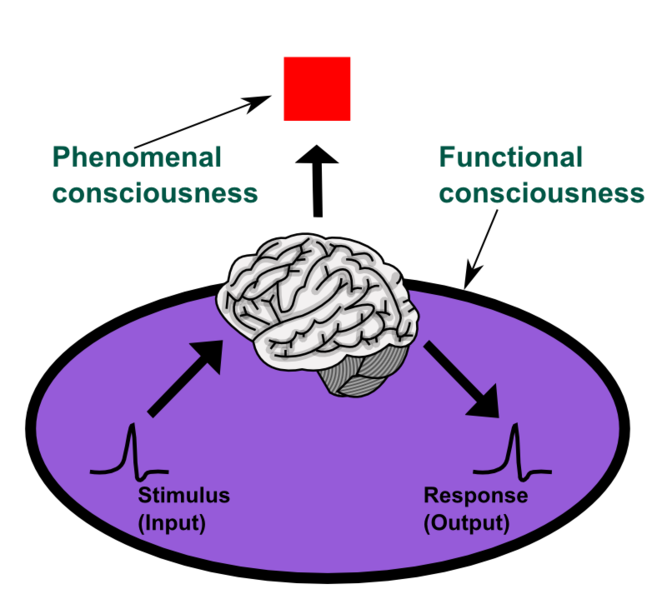
The hardest thing in philosophy is coming up with a genuinely hard problem. The most impressive thing for a philosopher to accomplish is to come up with a genuine hard problem and to articulate it in a very clear way. By these criteria, there is no doubt that Chalmers has accomplished something impressive through his notion of the ‘hard problem’ in philosophy of mind. With this sincere kudo out of the way, let me make forth with a reservation. I’m not completely sold on Chalmer’s distinction between the phenomenal and the psychological, and not being sold on this, I wonder if he really has picked out a genuine hard problem. No doubt the problem he has articulated is genuinely hard, I’m just not convinced that it’s a genuine problem.


Chalmers opens The Conscious Mind (all citations below are to this edition) by insisting that two concepts of mind exhaust all there is to say about mindedness: these are the phenomenal and the psychological. The psychological concept of mind encompasses a broad definition of the field of cognitive psychology, and as such, is primarily oriented toward explainnig the behavior of minded organisms in terms of inner processes or mechanisms—such mechanisms might be striclty neurological, computational, connectionist, informatic or even Freudian (and by the way, don’t worry about meaning of ‘inner.). The phenomenal concept of mind Chalmers approvingly defines through Nagel’s ‘something that it is like to be that [minded] organism,’ a unique property I like to call ‘what-it’s-like-ity.’ Chalmers points out that this sort of property will only allow ostensive definition, and typically can be pointed out only through its association with publicly recognized psychological states. Because of this, there is is always a danger to conflate the pychological and the phenomenal, and while this is fine for most everyday contexts, in science and philosophy especially we must always be mindful of the distinction.

“…for philosophical purposes and in particular for the purposes of explanation, to conflate the two properties is fatal.” (23)

Minding this conflation, Chalmers famously argues, gives rise to a division of labor among philosophers of mind, whereby the psychological matters, while extraordinarily complex, are in principle solvable. In Chalmers words, psychological issues pose immense technical difficulties, but no real metaphysical ones (this claim I suspect is too cavalier, but I’ll not make anything of that here). But because the phenomenal character of consciousness fails to fit into any acceptable current scientific or philosophical framework (since dualism is ruled out of court), it is this feature that poses the truly ‘hard problem’ in philosophy of mind.

So, what then is this phenomenal property, exactly? Again, Chalmers doubts, at least within any existing conceptual repitoire, that anything other than an ostensive definition associated with recognized psychological states will be possible. He chooses pain as an exemplary case. A roughly acceptable definition of pain can be given in psychological (i.e. functional) terms, but this leaves out the phenomenal feature of pain that, in the end, makes pain matter so much to us. Pain is exemplaroy here in that this fact is common to all sorts of mental concepts, viz. a phenomenal property supervenes on a psychological one but does not seem to be essential to that psychological property qua psychological. One is tempted to say that this what-it’s-like-ity is a sort of sensation, except that it is that very feature whereby a sensation (like any other mental phenomena) becomes a sensation. At the very least, it seems to be a rather logically simple, discrete and ethereal property, one that is incidental to the psychological state underlying it (indeed, this is the whole rub).

Does intentionality fit into any of this? Chalmers is confident that intentionality (and therefore the theory of intentionality) belongs on the psychological side of the divide. Chalmers—typical of most of the anglophone literature on the matter—defines intentionality through the notion of a propositional attitude, and therefore accepts the semantic concept of intentionality. On this semantic conception, to be in an intentional state is to adopt a sort a sort of attitude towards a propositional-like structure (a belief, typically). And since it seems that a plausibly psychological notion of belief is available (something like: ‘a belief is a doxic attitude towards a state whereby one’s behavior would be appropriate in a situtation if that proposition were in fact true, and such that this state is normally brought about when that proposition is in fact true’), we can quibble about whether some phenomenal state is also essentially involved with intentional states, but it’s probably not worth the bother (see pp19-20).

This is where I would like to register my reservations. Chalmers wants to argue that the phenomenal and the psychological come together merely contingently, as a matter of empirical fact, but not essentially. This seems wrong to me. He can say things like this because he chooses phenomena like pain, or hearing middle-C, or the sensation of red, as his examples, but these sorts of ‘raw feel’ examples, and pain especially, are very untypical phenomenal states. For the most part, the world is revealed to us through our phenomenal states, and the separation between the phenomenal and the psychological that Chalmers insists upon is rather the exception than the rule. In other words, for humans at least, phenomenal states have the peculiarity of being intentional, ie., they reveal objects therefore are world-disclosing. Thus the phenomenal and the psychological come together, not as merely concurring phenomena, not as a mere matter of fact, but through some sort of necessity.

What is actually peculiar about the phenomenal feature of human consciousness is that it is intentional, which is to say, that it is by virtue of our phenomenal consciousness that we are aware of an objective world. Now, this introduces the heady problem of what to count as consciousness of an objective world, and therefore, of how to understand ‘objectivity,’, but this problem—I want to stress—is a formal or logical problem, and not primarily, maybe even not at all, a scientific one, and it is certainly not a problem that Chalmers has cared to recognize. Moreover, I believe that this is a legitimately hard problem, but unlike Chalmers own hard problem, we at least have some respectable ways to think through it.

I am arguing that, contra Chalmers, the psychological and the phenomenal are not together as a matter of mere empirical fact, but through a sort of logical necessity. When we speak about this essential unity of the psychological and the phenomenal, we are speaking about intentionality. In a follow-up post, I will say more about what this sort of logical necessity is (spoiler: it’s mereological), so I want to finish with just this observation. I do not doubt that as a matter of fact we will someday be able to construct complex systems that are genuinely psychological in the sense relevant to Chalmers. That is, we will construct systems that will, without speaking merely metaphorically, learn, memorize, process information, believe, perceive, and so on. And I also do not doubt that there are plenty such beings alive on earth already, viz., all the more complex mammals and fish and reptiles (I have my doubts about them amphibians). Nor do I doubt that animals have a phenomenal consciousness, again in Chalmers sense. But from the fact that we can both conceptually and in reality separate these two aspects does not in any way require that their concurrence in human consciousness is itself also merely factual or contingent. This would be like reasoning from the fact that, since some organic visual systems do not detect color, that color is merely incidental to normal human vision, a fact that merely supervenes upon visual psychology. But that’s not right. Normal human vision is intrinsically, not accidentally, colorful.


Continue Reading...

Wednesday, July 16, 2008

Educational Policy and the Extended Mind

Here’s an apparent inconsistency: it seems that, given a century of psychometric study, that there are innate factors to intellectual performance that are rigid vis-à-vis enviornmental inputs and settings. No matter what you do or where you put them, some students will predictably excell at school, and others will fail. Better teachers, smaller classrooms, expenditure per pupil, a healthy diet from pre-natal development onwards, a nurturing home enviornment—these all have important effects, but even considered collectively, those effects are bound by what seems to be innate, even genetic capacities.

On the other hand, it is undeniable that we are all a lot smarter than our counter-parts a hundred years ago. This is not only true in terms of literacy rates, basic mathematical competence, graduation rates and college attendance. Even our IQ’s have been improving (by what is known as the Flynn effect).

The first observation suggests that we really ought to be quite a bit less ambitious when it comes to public education policy, lest we waste a lot of resources and energy for negligible marginal benefits, incurring high opportunity costs. Prudent public education policy would replace the goal of making everyone smart (a pie-in-the-sky or ‘romantic’ view), and orient itself towards finding ways to make the incorrigibly dim nonetheless productive workers. On the other hand, the second observation suggests that there are in fact important and measurable returns to investment in public education—witness the fact that most Americans can now read, and know enough arithmetic at least to fill out their tax forms.

Let me call these respective positions ‘What’s the Point?’ (WTP) and ‘Yes We Can’ (SSP). WTP often responds to SSP in the following way: yes, certain metrics like literacy, basic mathematical competence, graduation rates, even a base-line IQ, have improved over the centuries, most notably the past one. But this achievement has been merely to allow the full exploitation of a natural capacity, and we are fast approaching the time when marginal returns on education investment fast diminish. In other words, whereas some prudent social policies have enabled increasing numbers of citizens to achieve their natural potential, we have not affected that natural potential itself, and once we reach it, there is not much more that policy will effect. Furthermore, for many students, we have already past whatever natural potential they have, and are now expecting results that simply are not achievable.

WTPers are fond of an analogy between innate mental capacities and innate physical capacities. Take running. Just about every human being can run, and some can run faster and farther than others. Surely some of that is due to training, diet, confidence, dedication--but in the end, a defnite limit is reached, and an innate distribution of ability becomes evident. Thus, (so the WTP argument runs) it is just as much folly to expect every child to learn calculus and to quote Shakespeare as it is to expect every child to run a 7 second 100m or a 4 minute mile.

But let’s consider this analogy a little further. Observe that ‘innate’ capacities, like running, operate within what are in effect artificial constraints. To measure one’s ‘innate’ running ability, we require (for example) that aids like drug enhancers, bionic legs, superhero lung transplants, roller skates, and so on, are verboten. But we do allow for scientific nutrition regiments, super-tech training aids, the use of all sorts of biometric technology. Without any of these artificial constraints, the relevance of ‘innate’ ability becomes not only specious, but moot. With superhero lungs and bionic legs, who knows, maybe I could run a one-minute mile. The point being, if we refuse to abide by artificial constraints, ‘innate ability’ becomes not only irrelevant, but almost incoherent. (Consider this question: what is the ‘innate’ life-span? If the physicalists are correct, and brain transplants become one day possible, and new bodies can be grown ‘brave new world’ style, then….you see the point).

I wonder why we shouldn’t consider ‘innate’ intelligence along the same lines. The equivalent of Olympic-criteria for measuring intellectual performance in the United States is the National Assessment of Educational Progress (NAEP). Like the olympic sports, the NAEP sets up artificial constraints on the measurement of intelligence. The NAEP assesses skills in reading, math, science, writing, history, civics and geography. Verboten for students taking the NAEP are instruments like calculators, spell check, wikipedia, maps, and so on. But why do we insist on these constraints? It is hard to imagine very many scenarios where anyone in a ‘real life’ situation would not be able to avail themselves of any one of these technologies, so what is it exactly that we are measuring, and why?

The what is a very prickly issue, and innatists will get upset if you seem at all puzzled about it. But I think I can partially answer the ‘why’. We are still wed to a fundamentally Cartesian, fundamentally classical understanding of intelligence. According to this model, to ‘know’ something is to be a certain state, rather than to possess a certain ability. Thus, to ‘know’ that 98 + 113.5 = 211.5, or that the slope of a curve equals ∆x/∆y, is to have an intuitive insight into the nature of number, or in the nature of m. But consider for a moment: why is it that today, almost any decently educated 5th grader will be able to determine that 98 + 113.5 = 211.5, and any decently educated 8th grader will be able to solve for a slope-intercept? Before the development of a base-10 arabic numeral system, it would have been difficult for almost anyone to solve for the first, and before Descartes, to solve for the second. I am suggesting of course that there is a strict analogy between the use of a calculator and the use of a base-10 numeral system. Both are artifical, yet testers for the NAEP consider one’s ability to use the first still somehow ‘innate,’ while the latter is ‘artificial’—indeed, cheating. Why not then, instead of trying to measure some suspect ‘innate’ faculty, we instead measure ability—not under no constraints, but under constraints that are plausible and ‘realistic.’

Overall, then, I am suggesting that ‘innate’ intelligence no longer makes a whole lot of sense—although it still makes some sense, just like running—once we accept an externalist, “extended” theory of mind. In other words, we should take to heart the theory developed by Clark and Chalmers in their famous paper and apply it to the debate over innatism and educational policy. Returning now to the issue between WTP and SSP, we can at least partially explain the discrepancy noted at the beginning by recognizing that, because of technologies like a base-10 numeral system, even someone of ‘average’ intelligence can now solve for problems that, half a milennia ago, only the most educated and ‘innately’ intelligent could solve. That is to say, tests like the NAEP are in fact somewhat anachronistic, and I am sure that, if we did for instance allow for the use of graphing calculators, and the internet, that we would see marked improvements in test scores and therefore ‘average intelligence.’

Some caveats: this makes most sense when applied to mathematics, and to a lesser degree, skills like geography and history. That’s because the gains from technology (including symbol-systems) demostrably extend by orders of magnitude cognitive capacity. It’s not clear what role any such technology plays in writing and reading. I have some thoughts on this issue, but I’ll save them for the comment section if any one cares to explore the issue further.

Secondly, and less directly, I’m still not convinced that even on the innatists own ground and under their conditions that there is anything obvoiusly being measured. This is because I suspect that ‘innate’ ability, to whatever extent the concept makes sense, is influenced as much if not more by factors such as focus, attention, and motivation as by any raw capacity. The problem might be fitfully compared to the issue of indeterminacy. Whatever it is one is measuring by standardized tests, it will remain inscrutable whether performance results from raw capacity or from motivation, and so far, we have no reliable way (as far as I know) of controlling for one or the other. To see just how this issue informs the debate, check out this discussion.

Continue Reading...

Friday, April 25, 2008

Neural Antecedents of Decision: Some Phenomenological Skepticism

Web-happy philo-types are by now familiar with the recent study on “Unconscious determinants of free decisions in the human brain” by Soon et al., published in Nature Neuroscience. The study, which expands on the famous experiments performed by Benjamin Libet, purportedly demonstrates a seven second gap between the onset of neural activity involved in making a choice and the subject’s awareness of the choice. The details are discussed, among other places, at Not Exactly Rocket Science, Mixing Memory, NeuroLogica, and Conscious Entities; some interesting comments also at Alexander Pruss's blog. Essentially, participants were asked to press one of two buttons, and to take note of the letter showing on a screen in front of them at the instant they first become aware of having made a decision (Libet’s original experiments asked subjects to remember the position of a hand on a clock); all the while, fMRI scans were recording their brain activity. The comparison, then, is between two heterogeneous sorts of things: neural events, and conscious awareness.

One problem I have with these experiments is that they seem to assume a temporally thin notion of consciousness. Neural processes take time, which is why you can measure how long they go on before an action is carried out. They are temporally thick processes. But conscious awareness is apparently assumed to be instantaneous: we know the exact moment we become aware of something. This is a temporally thin notion: there is no gap in time between the instant we become aware of something and the instant we become aware that we are aware of it or, as in the set-up of the experiment, between the instant we make a choice and the instant we become aware of having made the choice. One obvious reply is to deny that there is any problem here, given a basic assumption that “becoming aware” and “becoming conscious” are synonymous. Surely there is an instant when I am conscious of my decision, say, or conscious of the position of the hand on a clock face (or the letter on a screen). And there is no real sense in which we can speak of something like being aware of such things without also being conscious of them.

But this sounds dubious. What these experiments measure, after all, is not simply when the subjects become aware of a decision. Instead, they measure when the subjects become conscious of that awareness. This is a reflexive process. But is there reason to think that the reflexiveness itself does not take up time?

To complicate matters, there are two reflexive processes going on. On the one hand, the subjects must become conscious of making a decision. On the other, they must become conscious of the letter on the screen at the instant that they become conscious of making a decision. This sounds like a fairly complex process to me, though maybe I am wrong. In any case, though, the process has got to take at least some time to perform. (That there is likely also some temporal gap between seeing the letter on the screen and registering that one has seen it complicates this even further.) What I am suggesting, in other words, is that there might be two temporal gaps that the experiments do not address sufficiently. First, there might be a gap between becoming conscious of a decision and becoming conscious of that consciousness. Second, there might be a gap between becoming conscious of that consciousness and associating this second-order consciousness with the awareness of a particular letter on a screen.

I worry about this, particularly, because the reflexive process is not involved in normal decision making. I either continue typing, or I stop to scratch my nose. But I do this without the second-order consciousness. I cannot, looking back at my action, pinpoint the exact instant when I decided to scratch my nose; normally, I cannot upon reflection even establish that I ever made such a decision, but this fact does not undermine my experience of having made the decision nevertheless. (This suggests, to me, that we may be better off not treating decisions, choices, or volitions as if they were events, and instead recognize them as interpretative abstractions.) So what I am questioning here is the idea that being aware of making a decision—in the normal way in which we experience making decisions in everyday situations—is really connected to the sort of consciousness of deciding that these experiments look at. What they are looking at is the process by means of which we thematize our decisions in consciousness; but this is neither something we normally do, nor is it something that seems central to our awareness of ourselves as deciding.

To top it off, I wonder to what extent the results of these experiments are even transferable to our everyday decisions. The subjects are specifically asked to pay attention to their decision and note the instant when they become conscious of it. But this is not something we normally do. Try it. Right now. Decide to scratch your nose, and then scratch it. When I do this, it feels weird: there is a doubling effect going on, as if I am performing the same action twice. In Searle’s terminology, the decision to scratch my nose is a prior intention, while the mental process involved in the actual nose-scratching is the intention in action. The prior intention in such simple actions is completely redundant. So if you are specifically looking for it, this seems to just distort what it is you normally do when you make decisions. When we ask people to locate the temporal instant at which they make a decision, we are asking them to do something extremely unusual, and the experimental data obtained from such exercises seems unlikely to be telling us very much about normal human decisions making; it might be telling us not what is going on in the brain when we make decisions, but what is going on in the brain when we try to catch ourselves making decisions, which is going to be a very different and very slippery task.

I am not just trying to be skeptical. What I am curious about is just the claim the scientists performing experiments like these seem to be making, i.e., the claim that we can scientifically study the relation between neural processes and consciousness or, at least, that we can do this given current technologies without either distorting or oversimplifying the precise thing we are studying. I am perfectly sure that we can study the neural processes. But it is not at all clear that we have the tools for scientifically studying consciousness. Why, then, should we think scientifically studying the relationparticularly the temporal relationbetween the two a currently plausible proposal? These experiments are certainly interesting for all sorts of reasons; I am uncertain that the light they claim to shed on conscious choice is one of them.

Continue Reading...

Tuesday, April 22, 2008

Cheating, Belief in Determinism, and Rationality

A new study has just appeared, showing that students are more likely to cheat if they believe in determinism than if they believe in free will. You can read a good summary of the setup and results of the study here. These results are interesting on all sorts of levels, but of course they are generally likely to be taken as indicating a link between belief in free will and moral behavior. I want to question that link here. My question rests on the following worry: is cheating in this experiment actually immoral?

Those who know me might know that I am actually fairly obsessed with cheating—rules against cheating and lying tend to control my behavior. But there is nothing obviously moral about this: I may avoid cheating just because I am uncomfortable with it, or worried that I’ll get caught, or concerned that if I get caught, I won’t be able to account for my behavior. That is: I find it easier not to cheat. And since I’ve internalized this rule, I tend to get angry when other people cheat. In other words, and pretty obviously, one’s reasons for not cheating are not necessarily moral ones; they are probably likely to not be moral, at least in any strong sense. (Some consequentialists, of course, might not buy this distinction between moral and non-moral rejections of teaching; if so, that would just show that they don’t quite get morality.)

Significantly, also, “cheating” is not necessarily immoral. As with most other types of behavior, its morality or immorality is contextual. In most situations—like those involving classroom work—cheating seems to generally be unethical. But what about an experimental setting? You are in a setting—as the students in this experiment were—where you can quite easily cheat on a test and walk away with some extra cash. So there is—as is often the case—an immediately obvious benefit to cheating, and virtually no risk of negative consequences if you get caught. From the standpoint of instrumental rationality, then, you should cheat.

But are there moral considerations that militate against the instrumental ones? Are you somehow violating justice? Or causing someone harm, by cheating? Perhaps: you are walking away with money that those who didn’t cheat also didn’t get, so you are outearning them by dishonest means and you are also, perhaps, slightly ripping off the experimenters, whose money you are taking. But the most significant consideration, it might seem, is that you are messing up the experiment, since you’ve been led to think that your honest performance, not your cheating, is what’s necessary for the experiment’s success. And this is where questions arise:

First, would you really be messing up the experiment by cheating? The experimenter has said she must leave the room, and you are to score yourself. If you know anything about psychology experiments, you should then assume that this experiment is already fatally flawed, and its data will be useless in any case. Second, if you know a little more about psychology experiments, you might suspect that such blatant opportunities for cheating are somehow factored into the experiment. If you suspect this, it seems to cancel out your moral objections to cheating; and since you know that cheating will get you more money, your instrumental rationality gives you an overriding reason to cheat. In other words: cheating might well be the most rational course of action in this experiment, and most rational not just in the sense of instrumentally more rational, but instrumentally + normatively more rational, since the normative considerations have essentially been cancelled out. In this case, if you refuse to cheat, you are not actually sticking to moral principles. You are sticking to habits that you mistakenly take to be moral—mistakenly, because in this context there is nothing clearly moral about them.

Of course I could be wrong on this; maybe cheating in this case really is immoral. But it is at least not obviously so. And if you stick to your (normally) moral principles even in situations where they are not moral, then you are not acting morally. You are just acting irrationally. And this, then, is the upshot: belief in determinism might simply make people more rational.

Continue Reading...