Showing posts with label Sartre. Show all posts

Friday, October 26, 2007

Sartre the Womanizer (II): Lying, Ethics, and the Freedom of Others

Apologies for the long blogging hiatus. There was a cancellation of my internet access, followed by a traumatic return from Germany back to the land from which my accent (and spelling) originates, another conference paper, job applications, etc. But now I’m back—blogging is the best stress relief. In the last post I tried to sketch out a problem with a completely unlimited conception of freedom: particularly, that freedom tends to undermine itself. People who freely choose to lie and to put themselves into situations where they feel compelled to lie end up with a nasty habit of lying. Here I want to take up the ethical aspect of lying by looking at what lying has to do with the freedom of others.

Let’s try a continuation of the imaginary conversation with Sartre started in the last post. First, here’s an objection that could be raised to Sartre’s approach:

T: But doesn’t lying to people undermine their freedom, their ability to make decisions about their lives, by depriving them of somewhat crucial facts—in this instance—about their relationships?

If, as Sartre often insists, he is committed to the freedom of others, then this really does seem to be a problem for him. Of course there are really two senses of freedom in operation. First, there is the freedom that we all have at all times just by virtue of being for-itselves rather than in-itselves. It would not make much sense to be committed to the freedom of others in this sense, since every person is already, by definition, free in this sense (though one can be committed to the authentic exercise of freedom by others; more on this below). The other kind of freedom, which I will call voluntariness to distinguish it from the first kind, is freedom from external constraints. Some of these constraints are political, and removing those was an important project for Sartre. Other constraints are matters of knowledge, particularly of the circumstances relevant to one’s exercise of freedom in the first sense.

Recall that Aristotle, in the Nichomachean Ethics, includes certain kinds of ignorance in the list of circumstances that reduce an agent’s culpability and voluntariness. If I give my friend a piece of string without knowing that he plans to use it to make a detonator, then my action of aiding in a terrorist ploy can hardly be considered voluntary. In the rather extreme case where I am completely ignorant of all the circumstances relevant to understanding my actions—if, for example, I am in some delusional state—then none of my actions are voluntary. I may still be free, in the sense that facticity does not necessitate my actions, but my freedom is completely worthless since I have no genuine control over what I am doing; only an ability to originate my actions. Lying to others about circumstances relevant to their decisions obviously deprives them of knowledge they would need to maximize the voluntariness of their actions. Consequently, lying to others decreases the value of their freedom. This can hardly be a good thing.

But perhaps Sartre can deny that his lying has such dire consequences:

S: Their freedom is not undermined at all! They choose to believe my lies!

That is, when we lie, we lie to a person, a for-itself, who is free to take our words any way she sees fit. The responsibility for the decrease in the other’s freedom is thus conveniently transferred from the liar to the silly person who falls for the lie. This can happen in two different ways. First, the other person does not have to believe what the liar tells them. They can exercise a general skepticism about anything they are told. Or, perhaps, the women should pay more attention to how Sartre acts and less to what he says. If they simply accept his lies at face value, they are being naïve. The fault is entirely their own.

Second, they might recognize that Sartre is lying, but deceive themselves about this fact, pretending that the lie is true. When Sartre lies to a woman he is seeing with the goal of getting her to stay with him, doesn’t she simply choose to believe him because, even though he is lying, she really wants to stay with him and needs an excuse to do so? If she chooses to believe him, she does so in bad faith. The fault, again, is her own.

But clearly neither of these tactics gets the liar off the hook. The reason is simple: presumably, Sartre does not lie to women because he is pathological; he does it because he wants them to overlook his infidelities and trust in his commitment. A non-pathological lie—that is, a lie told in order to attain some goal—has its acceptance as part of that goal. One does not, normally, lie unless one intends the lie to be accepted. The other’s acceptance of the lie aids in the attainment of some goal. But this just means that the liar, in lying, is already committed to the other’s bad faith. The liar aims at a conflict—a war of freedoms. He pits his freedom against the freedom of the other, his authenticity against the other’s inauthenticity. (The exercise of one’s freedom against the freedom of others is brilliantly attacked in Camus’s Caligula, possibly his best work.)

Regardless, then, of whether Sartre intends that the women believe him because they are naïve or because they want to believe him, in lying he commits himself to their bad faith. One simply cannot systematically lie to others while claiming to be committed to their freedom—either the authenticity or the value of their exercise of freedom is undermined. The ethics of the liar cannot be an ethics of freedom—at most, it can be an ethics of personal freedom, but it assaults the freedom of others.

Taking this together with the last post, my suggestion is that there cannot be a Sartrean ethics of freedom. What Sartre’s major influences—Kant, Hegel, and Heidegger—all recognized is that freedom cannot be a freedom of indifference. A freedom without internal norms is self-defeating, because in various ways it undermines both one’s own freedom and that of others. My own feeling is that Sartre’s mistake lies in understanding freedom primarily with regard to the particular rather than the universal. That will have to wait for another post.

Addendum: Fido's comments raise a point that I should throw in with the post. It is a point about whether freedom can tolerate internal norms. I think it has to, though it cannot tolerate external norms. This ties in with a further question: Could Sartre simply bite the bullet and drop ethics altogether? It seems like it is possible to just say, "Well, okay, I must be committed to my own freedom, to my own authenticity, but not that of others. That would be nice, but it isn't necessary." But I don't think so. A commitment to freedom involves a commitment to everyone's freedom. This is an internal norm. If I did not have this commitment, then I would be placing a limit on freedom—I would be concerned with freedom only as limited by my own person. And this would be an external norm. In any case, though, even a truncated Sartrean account cannot do entirely without internal norms: our freedom commits us to acting in the full awareness of that freedom, i.e., to authenticity.

Continue Reading...
Thursday, August 23, 2007

Sartre the Womanizer (I): Habit, Character, and Self-Deception

I hope in an upcoming post to throw out some thoughts about the relation between a philosopher’s life and thought, and in what ways we might reasonably connect the two. For now, I want to take Sartre as a test case. Recently, I watched a BBC documentary about him. These documentaries have, by their popular nature, a tendency to reduce thought to a mere response to particular life circumstances. In Sartre’s case, however, something interesting happened: the documentary stressed transcendence. Thus, while attributing Sartre’s rather extreme views on human relationships to his experience of being ugly, the documentary also emphasized his freedom in his attempt to work out a coherent political project through both his interest in Marxism and his later repudiation of it. But it was the brief discussion of Sartre’s tendency to sleep around that struck me. Olivier Todd recounted the following story (which, apparently, he has recounted quite frequently, both in conversation and in writing):

I remember asking Sartre, “how do you manage with all these women in your life?” And he would say, “well, I lie to them,” with this gesture of his arm. And I then said, “To all of them?” “Yes, to all of them.” “Even to Beaver?” “Especially to Beaver!”

This is interesting for any number of reasons; in the present context, because it does not strike me as a particularly strange thing for Sartre to say given his views of freedom. Unlike some features of a thinker’s biography, which may indeed be largely irrelevant to philosophy, this one seems to me to be a great example of the Sartrean notion of freedom in practice. Taking it as a sort of philosophical experiment, we can find here a kind of reductio of absolute freedom. Let’s work out a line in the form of an imaginary continuation of the dialogue:

T: How can you justify lying to all of them?
S: I can lie or not lie. What matters is that I choose to lie or not to lie, and that I make that choice in full awareness of the dreadful burden of my freedom.
Given the various positions laid out in “The Flies” (Orestes’ justification for murdering his mother and the king), Being and Nothingness, and “Existentialism is a Humanism” (especially the discussion of Flaubert), I think this is rather close to what Sartre would say. I am guessing, really, that this was how he rationalized his womanizing to himself. But there are two obvious difficulties here. The first has to do with the character of the liar and the problem of habit. The second (which will be the topic of my next post) having to do with the freedom of others.

A tradition stretching from Aristotle to van Inwagen is rather firm on the way habituation works: by choosing to lie, I take upon myself not only the responsibility for this choice, but also for the future consequences it has on my character, which every vicious choice corrupts. Sartre might have little patience for such views, since it is always possible for us to transcend the corruptions of our character. To think that my choices shape my character in ways that determine my future choices is to fall into bad faith, to take myself as facticity rather than transcendence. But this is a typical flaw in Sartre: the stark contrast between facticity and transcendence tends to miss the grey area between the voluntary and the involuntary (a flaw emphasized by Merleau-Ponty and Ricoeur). In his obsession with our ability to transcend our facticity, Sartre misses the phenomenological features of character such as temptation, rationalization, and, in general, everything that falls under the Kantian rubric of radical evil: having a capacity to be free is no guarantee that we will fully exercise that freedom. Our choices shape who we are and, because (as Sartre admits) self-deception is inevitable, our choices can strengthen that self-deception and undermine our exercise of freedom. It is precisely for this reason, one might say, that an ethic based on freedom must pay careful attention to that which—with or without our consent—undermines that freedom.

That we are free—in the Sartrean sense—does not, in other words, mean that all ethical determinations are ones we freely choose. We can see why by looking at two points. (1) First, Sartre does think that our radical freedom implies that we have a certain kind of obligation toward fostering that freedom—that is, there is an imperative to make decisions in the recognition of our freedom. (2) Sartre would reject the claim that lying is essentially a vicious act—if I freely choose to lie and freely commit myself to this choice, I affirm it as an ethical act. The problem, as I have tried to point out, is that contra (2), lying (despite being warranted in some circumstances) is vicious in its essence precisely because it undermines our ability to act in the full recognition of our freedom (1). Because we are beings capable of self-deception, and so beings that do not always act in full recognition of our freedom, we have an obligation—insofar as recognition of freedom is demanded of us—to avoid freely choosing whatever undermines this recognition. If the exercise of our freedom in full awareness is a value demanded of us by our freedom, then other hierarchies of value necessarily spring from it. Freely choosing lying is an unethical act precisely because—even if chosen in the recognition of our freedom and with the proper assumption of responsibility—it is an act that undermines our freedom.

Continue Reading...

Sunday, August 19, 2007

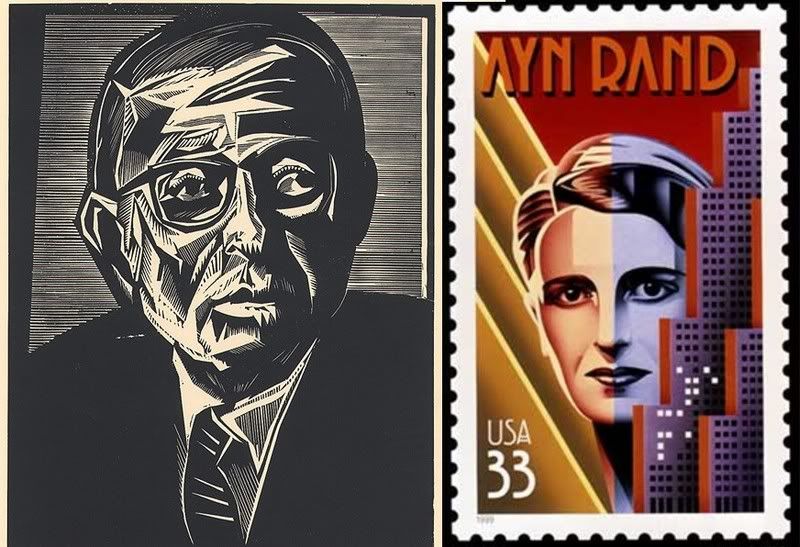
Sartre and Ayn Rand Would Have Had Some Weird Children


I am planning a slightly more involved post on Sartre for tomorrow, but I wanted to preface it with a question that has plagued me for some time. Are Sartre and Ayn Rand just cultural variations on a theme?

As a disclaimer, let me point out that I think Sartre’s nifty. Also, reading Sartre was one of the factors that pushed me from being interested in philosophy to wanting to study it professionally (I know I shouldn’t admit things like this publicly, but in my defense: I was 16 at the time). And I still think that, in many ways, Being and Nothingness is a genuinely great work of philosophy: it was one of the very few major works that aimed not just at resolving abstract metaphysical problems, but very sharply followed that ancient dictum of philosophy: Know Thyself. Sartre’s account of self-deception and the numerous permutations of it worked out throughout the book serve me well to this day in analyzing both myself and other people.

My feelings for Ayn Rand are a bit less warm. I read The Fountainhead when I was 17 (in order to enter the essay contest) and tried to follow up by reading some of her theoretical work; fortunately, I’d already read enough real philosophy by then to find her pretty laughable. I still think The Fountainhead is, overall, a good novel despite being seriously undermined by the attempts to get a “message” across (though Sinclair Lewis’s Arrowsmith is a more realistic and overall superior attempt at something similar: for one thing, it’s peopled by real characters rather than thinly disguised social virtues and vices). But really, I pretty much think Rand is a joke. Sartre, on the other hand, isn’t. And his tireless political commitment, though occasionally misguided, is impressive. So, what’s the connection?

What they share, really, is a similar delusion, or perhaps a similar lie: that they are conveying an uncomfortable truth when, in fact, they are telling the people exactly what the people want to hear. Let’s look at Rand’s case. The harsh truths she tells her American audience go something like this: Capitalism is wonderful. The world is objectively real. The highest value is individuality. Individuality consists of never collaborating with others, as that would water down the uniqueness of this individuality. And, naturally, morality requires that we care only about our own happiness and self-interest. Yup, integrity means looking out for number one. Obviously this is earth-shattering stuff.

Sartre is a better writer (though he also has a tendency to undermine the plausibility and readability of his fiction by overly un-subtle philosophical messages), and a much better philosopher, but this is to be expected: the French public is simply more demanding of its intellectuals. But what seems a bit disingenuous are his remarks about the “dreadful burden” of our freedom. He is telling a public that has just emerged from an occupation (in which many were complicit), a public that no longer trusts the old values, that, hey, it’s ok: the old values are only right if you choose them. And you’ve got the power to break free. All you have to do is recognize it! Sure, Sartre was accused of corrupting the youth and preaching despair, and I suppose his philosophy would’ve been more troubling if he were not preaching to the choir. But in that case, he wouldn’t have become the wildly popular figure that he was, and nobody would’ve cared what he was preaching. And yes, as I will discuss in my next post, there really is a troubling, dreadful element in Sartre’s view of freedom; whether he saw what it was, however, is questionable.

Lastly, both made the argument that one particular value (the individual’s life for Rand, freedom for Sartre) was the highest of values, since without it no other values are possible. Unless I’m missing something, both arguments commit the same fallacy of thinking that a necessary condition for the existence of values both (1) necessarily has value in itself, and (2) is of more fundamental value than any of the values that follow from it. (And yes, all of this is just a teeny bit caricatured. This isn't one of my serious posts. You probably guessed that from the title.)

So while I will go on reading Sartre, slipping him occasionally into papers, and having late-night debates about him over beer, while ignoring Rand and making fun of her followers, I just can’t help wondering if they were cast from a similar mold. All this, of course, pertains not so much to similarities in their philosophies, but similarities in what made them famous. But we can be a little more serious tomorrow...

Continue Reading...