Tuesday, April 10, 2012
Wednesday, May 20, 2009
Review of 'Knowledge, Belief and Reasons for Acting': Jennifer Hornsby
Here I assess and evaluate the first section from Hornsby's paper where she tries to support the claim that knowledge is necessary for objective reasons to occur as reasons in a reason-giving explanation of the agent's activity. In the end I argue that her argument fails to establish this and that her formulation of the principle that governs acting for objective reasons must be revised. Yet, I remain sympathetic to her suggestion and think that arguments can be supplied to support knowledge's essential role in reason-giving explanations although I leave it to future work coming up with such a principle.
SHORT INTRODUCTION: KNOWLEDGE IN AGENCY
In this paper Hornsby tries to find grounds for thinking that an agent’s possession of knowledge is presupposed by the agent acting for reasons and thus for the claim that acting for reasons does not come into play unless the agent has knowledge. The tendency to explore knowledge’s role in action theory is one she shares with a number of other philosophers: Jason Stanley suggests in his paper together with Tim Williamson that knowing that p is a reason for F-ing is a necessary condition for rationally F-ing whereas Stanley together with John Hawthorne takes the step a bit further and explores and defends the idea that knowing that p is a reason to F is both necessary and sufficient for rationally F-ing. On the other hand, we have people like John Gibbons who thinks that intentional action without knowledge is impossible and thus that knowledge is presupposed in some form or another whenever one says of some agent that she intentionally F-d. Hornsby seems to be on roughly the same track as Gibbons since she too is exploring the metaphysical foundation for actions rather than merely asking, like Stanley, Hawthorne and Williamson, about the norms or ethical principles that govern rational conduct. Important as the latter question is Hornsby sees herself as going further than the normative question to pose questions about the metaphysical constitution of actions.
Hornsby seems to start out by picking up a clue from Williamson’s suggestion (2000, p. 62) that knowledge sometimes must figure in the best explanation for why some agent F-d. According to him, attributions of knowledge may be a better predictor for determining someone’s actions by lending more probability to a certain way of conduct. The intuitive example is the rational burglar who risks a lot by searching the whole building for a valuable diamond. The only way to understand why a burglar would take such a risk is, according to Williamson, by attributing her with the knowledge that the diamond is in the building. Otherwise it would be hard to explain why she apparently disregards evidence to the contrary—i.e. as the time goes and her search is not successful—on pain of diminishing her rationality (like declaring her to be just plain stubborn, insensitive to evidence etc.). Another example would be the case where someone, say your mother-in-law, comes to your door ringing the door bell and you consider whether to open the door or not. The outcome of one’s deliberation should depend on whether you have reason to think that she knows that you’re home or whether she has a mere true belief to this effect. In other words, the predictive outcome—i.e. whether your mother-in-law becomes insulted or just disappointed—depends on the presence or absence of knowledge. The relevant generalization needed for explaining these cases—which, by the way, is how Williamson likes to think about the notion of causality—thus seems to depend on knowledge in certain intuitive cases of human conduct. In this sense knowledge is causally and psychologically relevant for human conduct.
However, if such cases goes through they suffice to show that there are at least some cases where attributing knowledge to the agent provides the best explanation of his or her behaviour. Thus, knowledge is sometimes needed in psychological explanation since in those cases it would severely decrease the explanatory power of psychology if we were to restrict that discipline from attributing cognitive states like knowledge to the agent. Beliefs won’t suffice to rationalize or to provide a reason-giving explanation here so, pace Stephen Stich and psychology’s restriction to autonomous behavioural description (i.e. a description of a way of acting such that if you would act in a certain way in a given setting so would your replica that shares all your current, internal, physical properties (Stich, Folk Psychology, p. 167)), we should think that what knowledge adds to beliefs is psychologically relevant. (Of course, one could reply here that those limits to psychological explanations might be just what we should expect since this discipline is, after all, not an attempt to explain everything. Agreed, however, I do think that Gibbons’ paper on this topic provides us with plenty of cases that one would like to be explained psychologically and where one nevertheless would fail to do so without attributing the agent with knowledge. Thus we should reject Stich’s restriction to autonomous behavioural descriptions. The point is that since which psychological states there are is at least partly determined by what one needs in order to explain human behaviour it seems arbitrary to exclude knowledge as psychologically irrelevant unless one can provide a more principled distinction between which of these states are psychologically relevant and not: again, the failure of such attempts is discussed in both Gibbons (2001) and Williamson (2000, chapters 2 and 3)).
MAIN TEXT: SECTION 1
What Hornsby wants to do is to take these ideas a bit further and actually put knowledge into the constitution a specific kind of agency, namely the agency that goes by the label acting for reasons; or, as she puts it, “until it is allowed that our knowing things explain our acting, our acting for reasons is not in view”. In order to get there we need to make a couple of preliminary distinctions. An intuitive and much-discussed distinction in reason-explanations goes between the subjective sense in which something is a reason for F-ing and the objective sense in which something can be a reason. The latter is, according to Hornsby, a matter of fact that obtains regardless of whether the agent is considering that reason as a reason for F-ing. The former is another kind of fact: namely the fact that the agent considers some p (whether true, false or plain stupid) to be a reason for F-ing. The following schemas cash out this distinction:
OBJ: A reason for A to F was that p: p
SUBJ: A had a reason to F: she believed that p: Bp
The distinction can be appreciated with an example: suppose A goes skating on the edge of a pond and clearly avoids skating in the middle of it. Suppose further that the ice is too thin for skating in the middle of the pond. Now, according to Hornsby, that fact is a reason for A to skate on the edge of the pond as well as avoiding the middle of it. For short, call that fact P. A may now be acting for a reason in the objective sense, thus skating in the middle of the pond for the objective reason that P. On the other hand, there’s another way in which A may have a reason for skating at the edge of the pond and that is the subjective sense in which she believes the ice in the middle of the pond is thin. What’s more, her belief that the ice is thin might also be the fact that causes her to skate on the edge. Hornsby’s point is that both are reasons for the agent to skate at the edge of the pond given that she desires or wants to remain safe and dry. When we explain human actions we need both and we need to show how they are related. Hornsby’s claim in this paper is that in order to achieve both ends—i.e. explaining human conduct and how those different action explanations are related—it is required that we credit agents with knowledge. Let’s see if she can establish this claim.
The reason why we need subjective explanations may seem obvious to some, especially to the Humeans in action theory, like Donald Davidson, who thinks that a reason figuring in a reason-giving explanation or rationalization must “lead us to see something the agent saw” (Davidson 1965, p. 3); but it might be worth rehearsing its intuitive appeal. Hornsby resurrects Bernard Williams’ example where someone makes a mixture of petrol and tonic because he wants to drink gin and tonic and believes the petrol being gin (despite the smell...). In such a case there was no reason for making this particular mixture. After all, what the agent wanted was something of a totally different kind; what’s more, the mixture could be quite toxic and dangerous to the agent’s health (no suggestion here that gin and tonic is particularly healthy either...). But all this does not mean A had no reason to making this mixture since A still had her reasons for making the mixture as she did. The distinction that we need to make here is the difference between two existential claims, namely the fact that there is no reason for A to F is non-identical to the claim that A had no reason to F. Or in symbols:
~$p (p is a reason for A to F) ¹ ~$q(q is A’s (or her) reason for F-ing)
In other cases one’s belief, although true, might be rather silly and not even remotely connected to what one wants to achieve by acting. Hornsby calls these cases benighted agency. For instance, if I believe truly that my 30th birthday is 10.02.2009 and I take that to be a reason for me to make a first bid at 30.100.220,09 $ for a flat in Queens, there’s a sense in which I’m clearly benighted in my activity. Such examples are supposed to show the need for the subjective sense in which something is a reason for F-ing: they may be true, false, silly or just plain stupid, still they are the reasons for which A, as a matter of fact, is F-ing since the agent takes those as reasons for F-ing and acts on them as such. What happens it those cases the agent acts on her belief that P is reason for F-ing and then, from A’s perspective, there would be an objective reason to F if P were true.
To account for the objective sense in which something is a reason for A to F we only need to point to the fact that P is reason for A to F, i.e. OBJ. However, to make that reason figure in a rationalization or reason-giving explanation of A’s activity it is not enough to just cite this objective fact. After all, there might be a perfectly good reason for me not to be writing this blog post at this moment; but that does not make it a good reason to cite, as it stands, in a rationalization for why I am struggling to write it. Would a belief do the trick? That is to say, would it capture the objective sense in which something figures as a reason in a rationalization of one’s activity if the agent truly believed that P was a reason for her to F and acted on this belief? According to Hornsby, the answer is clearly no and the true belief that P is a reason to F do not add up to all we want from the rationalization. The true belief could be result of a mere happy conjecture or just the result of a lucky happenstance in which case Hornsby thinks that “inasmuch as the skater’s belief could have been false, the skater’s believing what she did can hardly provide her with the reason that there was for her to keep to the edge.” For instance, if A was told that the ice was thin by an otherwise reliable friend who for some reason was out to trick her from skating at the centre of the pond, it will be true that the ice was thin (unbeknownst to the friend’s knowledge) and A will have and act on this true belief. Yet, there is a sense in which the friend’s attempted trickery ruins the way in which we expect the agent to be connected to her reasons for acting; it requires something more than just a Gettierized, justified, true belief that P is a reason to F to be provided with that reason in the objective sense.
Of course, any interesting or empirical belief “could have been false” so I guess we should read Hornsby’s suggestion here as saying something to the effect that a mere belief “could easily have been false” in order to retain a charitable reading. By that I mean that one’s belief, although true, could have been true as a matter of epistemic luck—as shown by the Gettierized case—and that Hornsby thinks this presence of epistemic luck suffices to block the agent from being provided with the reason there was for her to skate at the edge of the pond. If that reading is correct we can begin to appreciate the intuitive connection between agency and epistemology/knowledge: we could say that something goes missing in this case—i.e. the possibly Gettierized scenario—and that “what one needs for one’s true belief to provide one with a reason for skating on the edge of the pond is that the belief be not only true but also epistemically reliable (i.e. holding true in all of one’s epistemic alternatives)”. Here the reliability relation could be defined as an ordinary accessibility relation in modal logic that is defined as function from the world one is in (@) to the possible worlds one for all one knows have been in (i.e. the set of those worlds that are consistent with all one’s evidence in @). P is the reason for A’s F-ing then (i.e. the reason because of which A’s F-ing) only if P is (a) true; (b) believed; and (c) reliably based. In the Gettier case condition (c) fails and we will have to say that A kept to the edge of the pond not because the ice was thin but because he believed (correctly) that the ice was thin. So his true belief does not provide him with an objective reason for acting because it fails to be reliably based; so adding the true belief to the objective reason merely gives you another subjective sense in which P is a reason to F.
Now if A were to know that the ice was thin and thereby acting on her knowledge she would satisfy the reliability condition—after all, knowledge requires being reliable—and thus there would be no obvious reason to deny that the fact that the ice is thin now provides A with an objective reason for skating on the edge. So the presence of knowledge is enough to provide A with an objective reason for which she acted. But Hornsby makes the further claim that knowledge is also necessary or that a condition for F-ing for the reason that p is that one knows that p. Her Gettier case obviously does not establish that knowledge is necessary; reliability, for all that’s been said and done so far, could possibly be supplied for by other means. Yet knowledge is a plausible candidate and also one that frequently occurs in normative and rational evaluations of people’s activities (for evidence see: Stanley and Williamson; Stanley and Hawthorne). We might also think that the necessity requirement could be established via lottery considerations, i.e. cases where the requirement of justification needed for acting with an objective reason is pressed increasingly towards probability 1 (= knowledge); but I won’t go in this now. Suffice it to say that more is needed—and can probably be provided—in order to support Hornsby’s main claim that: “We act for reasons in virtue of our having knowledge of relevant facts. As agents, we rely upon our often being, so to speak, the conduits of facts.”
We should note, in passing, that Hornsby’s suggestion does not preclude that p could still be a reason for A to F even though he is unaware of it or fails to know it and merely believes it. The point is rather that as soon as he acts his F-ing can only count as F-ing for the objective reason that p if A also knows that p. Failing that he would merely be F-ing for his subjective reason in accordance with his objective reason, i.e. by acting for the correct belief that p was a reason for F-ing. So the fact that p is a reason for A to F can only occur as an explanation of A’s actual F-ing if A knows that p is a reason for A to be F-ing. In this sense, Hornsby’s suggestion is completely on a par with Davidson’s requirement that a reason can only figure in a rationalization of someone’s behaviour if it shows or “leads us to see something the agent saw” (1965, p. 3); when we explain that A knows that P is a reason for A to F just is a way to come to understand something the agent saw. Davidson also lists knowledge as one of the possible cognitive attitudes we can list and combine with a pro attitude (desires, wants, etc) to yield the primary reason that rationalizes A’s intentional behaviour.
Anyway, Hornsby goes on to suggest that (E) captures what she thinks established by her Gettier case:
(E) Where ‘x F-d because p’ gives a reason-explanation (x F-d because p iff x F-d because x knew that p).
I think I see a problem with (E): it seems to be a version of the KK principle and thus leads one to the absurd consequence that follows when one applies an S4 model for the accessibility relation that operates on the epistemic operator. That is to say, Hornsby’s suggestion can easily be shown to require much more reliability and knowledge than first assumed. Here’s why:
Read F(x, p) as ‘x F-d because p’
Read K(x,p) as ‘x knew that p’
Then according to my reading of (E) as an instance of what is troublesome in the KK principle it would follow from F(x, p) that F(x, K(x,p)): F(x, Kx(K(x,p))), and so on. In short, it follows that whenever one acts for the objective reason that p one would have to not only Kp but KKp, and KKKp, etc.. The reason why this is a problem is that, according to Hornsby, the presence of knowledge adds reliability and thus it adds a restriction on one’s epistemic possibilities: the space of epistemic possibilities shrinks with every addition or iteration of knowledge. Thus, the extent to which (E) can be shown to iterate knowledge requirements is also the extent to which one would require a higher epistemic standard whenever one acts for the objective reason that P. My allegation is therefore that (E) commits one to an impossibly strict epistemological standard in order to act for objective reasons.
The best way to deal with this objection would be if one could point to the scope of the principle since the principle’s application is supposed to be guarded by a qualification to apply only where ‘x F-d because p’ gives a reason-explanation. One could hope that this qualification could be enough to block the reiteration that would make (E) an instance of the fallacious KK principle; however, (E) is easily turned into an instance of the KK principle by Hornsby’s own words since she regards both the left-hand side and the right-hand side of the equivalence as a reason-explanation. Thus, whenever ‘A F-d because p’ is a reason-explanation it follows from the equivalence in (E) that ‘A F-d because A knew that p’ is a reason-explanation too. Since that is the case nothing stops us from reapplying (E) to ‘A F-d because A knew that p’ since (E) is a universal principle that is supposed to apply whenever something of the form ‘x F-d because p’ gives a reason-explanations: and, guess what, ‘A F-d because A knew that p’ has that form since ‘A knew that p’ is a fact too. It’s just that on the reapplication the variable ‘p’ in the schema is replaced by ‘A knew that p’ rather than ‘p’; so when we put that into the formula (E) it gives you back that ‘A F-d because A knew that A knew that p’. This process can now be repeated as many times as you want giving you an infinite number of iterations of knowledge as a general requirement for objective reason-explanations. In other words, to have reason-explanation for F-ing of the form ‘x F-d because p’ requires not only that one knew p but also that one knew that one knew p, knew that one knew that one knew p, and so ad infinitum. Again, the trouble is that knowledge adds further reliability thus restricting the epistemic possibilities: in short, one would need to know so much that it rules out any epistemic possibilities and thus one would need to know exactly which world one resides in order to act because that P. And no one, except for an omniscient being, knows that much which is an intolerable consequence of Hornsby’s suggestion. At least, so it seems to me.
A possible solution is to insist on two senses of because here: we could read ‘A F-d because that P’ as the sense in which something is objectively a reason for F-ing without being the ‘because’ that figures in a reason-giving explanation; and think of ‘A F-d because* she knew P was a reason for her to F’ as the ‘because’ that does figure in a reason-giving explanation. But that runs counter to the qualification or what we seek to explain, namely what we need for the citing objective sense of being a reason to F as a reason figuring in the reason-giving explanation for F-ing. As far as I can see, Hornsby is in real trouble here and I see no easy way out of it. (Note: it won’t help replacing the biconditional with a conditional, either; since the consequences only hinges on one direction of the biconditional).
Bracket this problem and I’m in sympathy with Hornsby’s general idea that, as she says, adding knowledge to the soup is an elegant way in which something can be a reason for F-ing at the same time as one can account for the agent’s motivation. Knowledge is factive and therefore Kp entails p; also knowledge is arguably a cognitive or mental state and thus can figure as a causal factor in the explanation of one’s acts. We still need a story about the subjective sense in which something is a reason for F-ing; or rather, we need to connect such a story to the one about knowledge. That is Hornsby’s topic for section 2 of this paper but I will return to that project in a blog post that is soon to follow.
REFERENCES:
Davidson, D, 1963, ‘Actions, Reasons, and Causes’
Gibbons, J. 2001, ‘Knowledge in Action’
Hornsby, J. 2007?, ‘Knowledge, Belief and Reasons for Acting’
Williamson, T. 2000, Knowledge and Its Limits
Labels: action, Hornsby, knowledge, philosophy, rationality
Thursday, April 17, 2008
Aristotle and Spinoza Were Primarily Analytic Philosophers. Haven't You Heard?
Alexander Pruss presents a fairly silly line of thought on his blog, in which he attempts to assimilate much of the history of philosophy under the analytic wing. To be fair, his goal is not to denigrate continental philosophy, and he does admit complete ignorance of it. Yet this does not prevent him from thinking that continental philosophers might also be able to trace themselves a philosophical history—he just thinks that history would be a bit different. But a bit of analytic re-colonization of history is clearly behind his thoughts, particularly when he says without basis that, “By and large, continental philosophy strikes me as a more recent development.” Oddly enough, continental philosophy also strikes me as a recent development. But then again, it is exactly as recent as analytic philosophy. An excellent response to Pruss is offered by Michael Pakaluk at Dissoi Blogoi. Readers of this blog, on the other hand, may be familiar with my response to such exercises in selective historical forgetting.
Pruss writes:
It seems to me that Socrates, Plato, Aristotle, Sextus, Augustine, Boethius, Anselm, ibn-Rushd, al-Ghazali, Maimonedes, Aquinas, Scotus, Ockham, Descartes, Spinoza, Leibniz, Locke, Hume, Kant and Frege all practiced analytic philosophy for a significant part of their philosophical lives—some of these, indeed, for just about all of their philosophical lives. When I read these people, I find them kindred souls, clearly engaged in the same rational pursuits, using pretty much the same tools, as I am.
Nor does the claim that continental philosophers are likely to have a different history all that cogent: Scotus, Descartes, and above all Aristotle, via both Hegel and Heidegger, are indispensable. And given the much more prominent role accorded to the pre-Socratics in the continental tradition, the idea that continental philosophy has a later history goes down the drain. There are perhaps some pre-20th century philosophers who play a greater role in the analytic than the continental canon, but such impressions often turn out to be illusory. Heidegger had nothing but contempt for the empiricists, but certainly both Husserl and Deleuze were lapping it up. Mill is a far more important figure for the analytics than the continentals, largely because utilitarianism never caught on across the pond (with good reason, I tend to think), and yet Mill’s influence surfaces in the social science interests of Dilthey, Gadamer, and Habermas.
What really bugs me, though, is the attitude we find in Pruss’s comment that,
most of the great medieval figures (especially Aquinas, Scotus and Ockham) are clearly primarily analytic philosophers and analytic theologians. Likewise Sextus and Spinoza. Since obviously continentals consider these figures as part of their history, it follows that a part of the history of philosophy for continentals does include some very analytic thinkers.
By the way, I've made this point before, but it bears repeating: if you've been trained in a particular way of doing philosophy, and have studied historical figures as the precursors to this way of doing philosophy, of course you are likely to find them engaged in an enterprise similar to your own! And if certain figures have been left out—as Hegel is often left out of analytic versions of history—it is no wonder that one will see them as belonging to a very different mode of doing philosophy. One value of the continental obsession with difference, as I see it, is precisely this: if you pay attention to the sorts of things in historical figures that you've been trained to pay attention to and recognize as continuous with your projects, your reading will be infected by confirmation bias. The more you focus on the surprising aspects of historical texts—those points where the thinkers say something you really have trouble wrapping your brain around—the more you are likely to learn something from them that you didn't already know. (Yeah, I happen to think that everyone, regardless of philosophical orientation, has a great deal to learn from Gadamer, if not with regard to concrete problems, at least with regard to how one can understand a philosophical text without turning it into a mere projection of one's own prejudices. Chunks of Truth and Method really should be standard reading in any graduate philosophy program.)
Lastly, these attempts at historical colonization always remind me of a passage from Walter Kaufmann, with which I leave you:
Existentialism without Nietzsche would be almost like Thomism without Aristotle; but to call Nietzsche an existentialist is a little like calling Aristotle a Thomist.
Labels: philosophy
Monday, February 11, 2008
Appiah on Experimental Philosophy: Damning Praise?
I’ve finally gotten around to reading Appiah’s New York Times article on experimental philosophy. I have to confess that I am a little surprised: on one reading, Appiah is attempting to gently curb the (possible) ambitions of experimental philosophy by showings its limits (a critique of experimental philosophical reason, if you will). But on another reading—the one that seems most natural to me—Appiah spends a page praising experimental philosophy, then suddenly turns the tables by first showing that you still need traditional “armchair” philosophy to clarify the results (for two reasons, that I’ll get to in a moment), and really goes on to suggest that experimental philosophy as such is completely unnecessary. Though this isn’t the way he puts it, my impression from the article is that his point ends up being: experimental philosophy is kind of cool, and it’s based on a philosophically important idea, but it’s that idea—not the experimentation—that matters.
Why do we still need the armchair philosophy? Referring to Joshua Knobe’s well-known work on intention attribution, Appiah puts it thus:
although experiments can illuminate philosophical arguments, they don’t settle them. For instance, is it a good thing that we attribute intention in the curious way that we do, and if so, why? (Is the Knobe effect a bug or a feature?) You can conduct more research to try to clarify matters, but you’re left having to interpret the findings; they don’t interpret themselves.
This looks like Appiah is giving one reason why experimental philosophy cannot replace—and, really calls for—traditional armchair philosophy, but there are in fact two reasons here. First, the most obvious reason: data is meaningless without interpretation. Everybody recognizes this, I think; it’s the reason experimental philosophers argue about their results and perform further surveys to try to close in on how the intuitions being studied are interconnected. But second, there is a philosophical reason, which Appiah raises with the question, “is it a good thing that we attribute intention in the curious way that we do”? This reason is distinct from the first one, because interpreting what one’s findings mean is different from what this second question calls for, which is not interpretation but normative analysis. Philosophy isn’t simply about clarifying our intuitions; it is also about asking whether having the intuitions we do is reasonable or justifiable or desirable. And this is the sort of question that cannot be settled experimentally, as far as I can tell. (Survey question: “What is your intuition about this? Do you think it is reasonable for you to have this intuition?” That wouldn’t help: respondents could answer the second question, but they’d just be giving a second, higher order intuition with regard to the first one. And then we’d have to ask, once again, whether the higher order intuition is reasonable or justifiable or desirable to have.)
Now, here is a bit from Appiah’s concluding praise of experimental philosophy:
The best work in experimental philosophy would be valuable and suggestive even if it skipped the actual experiments… X-phi helps keep us honest and enforces a useful modesty about how much weight to give one’s personal hunches, even when they’re shared by the guy in the next office.
And this, really, is the only thing Appiah seems to say in favor of experimental philosophy. But it isn’t much by way of praise. Certainly Appiah does not say that experimental philosophy has no value—what he is says is that it would be valuable even without the experimentation. And its value, on his analysis, is that it keeps philosophers from taking their own intuitions to be obvious truths. But this isn’t a praise of experimental philosophy at all: certainly philosophers can and should be wary of taking their own intuitions, even if their acquaintances share them, to be universal or natural or obvious. But we can take that point away without handing out any surveys. If so, then what is the value of experimental philosophy qua experimental philosophy? Appiah doesn’t seem to say anything about that. Rather, he seems to do away with the sort of answer that might come to mind.
In a case of competing intuitions, he writes,
Both intuitions have their advocates, and the right answer, if there is one, isn’t necessarily to be determined by a head count.
This seems to be an overly conciliatory gesture: it’s not that a head count doesn’t necessarily determine which intuition is right; it isn’t clear how a head count could serve this purpose at all. Genuine philosophical problems just aren’t problems to solve by a head count, because head counts don’t solve normative problems. A head count might tell us who the next president of our country will be, for example, but it won’t and can’t tell us who the right president for our country will be. A head count can, of course, answer a question such as: “Is intuition X universally shared?” But that question isn’t a genuinely philosophical question at all, and it seems to me that it isn’t a genuinely philosophical question precisely because it is an entirely empirical one. In any case—a point Appiah does not make—it isn’t clear what would be contributed even by a survey that showed that a certain intuition really was universally shared. What would that do? It would still be a head count, and the fact that everyone agrees on X still doesn’t establish that X is right. It establishes only that everyone agrees on it.
That is, while Appiah doesn’t say that experimental philosophy (again, qua experimental) has no value, he doesn’t actually give us any reason at all to think that it is valuable. And in this regard I find his article—which seems, on the surface, to be a praise of experimental philosophy—extremely puzzling. In conclusion, though, I would like to suggest two uses for experimental philosophy that strike me as important.
1. Experimental psychology clearly does have some value. (I myself am rather fond of Piaget and Kohlberg; but of course there is a lot of other, and more recent, interesting stuff that philosophers have been exploring more and more in recent years.) And one of the problems with psychology, it has always seemed to me, is that psychologists often conclude their studies with grandiose philosophical claims that remain entirely underdetermined by the evidence. Collaboration between philosophers and psychologists would, hopefully, help to stem this trend, and help also to make psychological insight more obviously philosophically interesting.
2. Experimental philosophy can serve as a kind of normative therapy. This is not what one would call a traditional philosophical approach, of course, but I this is could be an important one. Take the case of individuals expressing their intuitions. And then ask them whether they think their intuitions are reasonable. Well, now, this latter question is something philosophers should be pretty good at dealing with. And what if, instead of simply collecting data from subjects, philosophers then turned around and helped the subjects analyze that data by helping them reason through their higher order reflections on their intuitions? On this approach, experimental philosophy would perhaps not feed back into philosophy proper. What it would do, on the other hand, is something genuinely useful to human beings.
Continue Reading...Labels: philosophy
Friday, February 8, 2008
Do Continental Philosophers Have Arguments?
It isn’t so uncommon to meet someone who thinks that continental philosophers don’t make arguments. I suspect that often this is the result of not having read much, if any, continental philosophy. But of course that isn’t the whole explanation. Perhaps some people have picked up the notion that continental philosophers don’t make arguments from others, but then those others, at some point, must have picked up the notion somewhere. So here I want to briefly say that the answer is: yes. Continental philosophers do make arguments. I am happy to refer anyone who doubts this to, e.g., sections 19-21 of Heidegger’s Being and Time, which feature his phenomenological critique of Descartes. Or to Badiou’s critique of Levinas in his Ethics (pp. 18-23 in Verso’s English translation). The real question is, why might it seem like continental philosophers do not employ arguments? The answer, I think, is that readers trained to recognize the analytic style of argument might often read a continental argument without noticing that it is an argument at all. I have already pointed out one reason for this in a previous post: continental philosophers have a tendency to embed their arguments within a wider conceptual scheme, in such a way that the arguments for the scheme and the arguments within the scheme are co-dependent.
But I think there is another reason why continental arguments often get missed, and this seems to me to reflect a general difference in the way analytic and continental philosophers understand the purpose of argument (an obvious but important point before I start: I am not describing a methodology common to all continental philosophers; nor am I describing a methodology that no analytic philosophers apply). Let me start this train of thought by saying something about arguments, which I hope will not come off as overly controversial or anti-rational: Knock-down arguments, at least against widely accepted positions, are exceedingly rare. Strong arguments, of course, are not all that uncommon. But strong arguments are not knock-down arguments; they are not, in other words, arguments the conclusion of which pretty much any reader must accept under pain of contradiction. Philosophers generally spend some time—a lifetime, or perhaps a week—thinking out a position, and they don’t abandon it lightly. If the position is at all cogent—or, sometimes, even if it isn’t but provides support for another position that many people want supported—it is unlikely to be dropped instantly in response to an argument.
The obvious point that philosophers generally tend to hold on to their positions has ramifications as well, ones that are familiar to anyone who opens an analytic journal. What typically happens when a strong argument is presented is not that the target of the argument rolls over, but that the target comes up with a defense, or a way of preserving her original position by either undermining the critique or avoiding its implications. This need not be understood as the product of simple ego inflation, though there is some of that, coupled with pressures to publish (I am, for example, somewhat at a loss for how else to explain the decades of literature about Frankfurt Examples). There are certainly solid philosophical reasons for maintaining an established position—it is, after all, established for a reason; presumably, it provides a particularly strong approach to some problem, or it lacks the deeper difficulties of its competitors. The point, though, is that a debate can often go back and forth indefinitely, and the waning of such a debate or the prominence of a position is often attributable to factors that have little to do with the rational force of particular arguments.
And here I want to suggest that one typical (though not universal) continental approach to arguments arises out of this recognition: arguments are viewed not so much as techniques used to demonstrate an opponent’s flaw, but rather as attempts to make intelligible underlying issues. An example (though not a continental one): Galen Strawson has argued that moral responsibility is impossible, because it requires of an agent that she be capable of self-creation. Certainly both compatibilists and libertarians have replies to this argument. But the strength of the argument seems to me to lie not in its point (since its point is, really, just the restatement of a very old problem and, as such, hardly worth restating again), but in its ability to make that old point—a point that, in its longevity, seems to reveal a deep underlying philosophical concern—intelligible within a different idiom and conceptual scheme. So while an analytic philosopher might take the arguments primarily as something to be defended or refuted, a continental philosopher may be more likely to look at the context of the arguments on both sides and to search for the deeper conceptual problems involved. Often this involves a method of looking for aporias (a method Ricoeur calls “aporetics”)—points at which both sides have been so thoroughly defended that the fruitful response is not to contribute to one side or the other, but instead to take the problem to be for all intents and purposes insoluble, and to seek the reason for this insolubility in the conceptual scheme common to both sides.
The goal of a continental argument, then, is often not to attempt to resolve a philosophical problem directly, but to try to make the problem itself clearer by providing an intelligible picture of why the problem appears so intractable in the first place. This may seem unphilosophical and, really, unsatisfying to those committed to solving the problem; but it involves the recognition that some problems cannot be solved, and they cannot be solved not because the terms of the problem are badly defined, or because a master argument has not yet been found, but because the problem itself arises out of a mistaken schema. One consequence is that this tends to make continental writing less contentious and more conciliatory—another reason that arguments might seem to be lacking. It is conciliatory in the sense that often continental writing proceeds not by attempting to show that a particular view is wrong, but instead by showing that it is inadequate to grasping a deeper problem. But instead of simply rejecting the view, the method often goes on to seek the truth of the position, roughly, what is right about the position in the sense that it can be used to make sense of the underlying issue. (An excellent example of this is Ricoeur’s writing in Oneself as Another—he begins by showing that P. F. Strawson’s account of persons in Individuals, according to which persons are the bearers of physical and mental properties, is insufficient for an account of selfhood, and yet throughout his argument in the book he returns to Strawson, reminding us that this dual attribution has to be kept in mind throughout.) I suppose this mode of argumentation comes from an assimilation of Hegel into the philosophical culture.
What may make this continental approach hard to recognize as argumentation, then, is that it lacks two features common to analytic argumentation:
1. Problems are often approached not by addressing them head-on, but instead by examining their context.
2. Positions shown to be “wrong” or inadequate are not simply rejected, but partially incorporated into a wider narrative.
This is, to be sure, a different way of doing philosophy, yet its credentials to legitimacy, especially as a form of argumentation, strike me as well-grounded.
Labels: philosophy
Tuesday, August 14, 2007
The Philosophical Conservatism of Post-Modernism
As I reflect on how or why this has occurred, I am struck by the suspicion that, despite its pretensions, philosophical post-modernism remained in a very fundamental and profound way conservative. This is not a novel thesis. It has been suggested already by Habermas. But Habermas had in mind a quasi- if not overtly political conservatism. I am referring instead to a philosophical conservatism.
This is evident in two ways. The first, a fixation on the subject, and the second, a mis-understanding about what was truly radical in the linguistic turn.
Despite it’s being displaced and de-centered, despite renouncing its sovereignty, and despite its subordination to the body and to affect, the subject never truly ceased being the focus of post-modern philosophical attention—or even obsession. Like the suppressed primal fantasy, the subject always returns.
By taking the subject seriously, the Heideggerian critique of presence seemed to have something intensely important, and epochal, to say. Similarly, the Derridean prognosis of the always already impossible achievement of this critique seemed equally profound and disturbing. This leant definition, and momentousness, to the ‘overcoming of metaphysics.’ But ignore the subject, and suddenly these projects seem pointless, if not silly.
And ignoring the subject is precisely what their counterparts across the Atlantic were doing. In this respect, Quine is far more radical than any of his continental peers. For Quine, rather than undermine, critique or work-through the subject, just breezily passed it by.
Secondly, post-modern philosophy simply misunderstood the linguistic turn by failing to notice that the important emphasis was on speech-acts, rather than symbols per se. Thus, in Deleuze, Derrida, Foucault, and their followers, we have what is, in effect, simply an updated Humeanism that takes symbols or the ‘text,’, rather than impressions, as the origin of the world, the mind and the self. Vastly over-estimating the importance of Saussure, while ignoring Austin, Wittgenstein, Quine and others, it seemed as if structuralism fronted a formidable thesis, and that the critique of structuralism was an essential endeavor. And this allowed it to seem plausible that the aforesaid ‘world,’ ‘mind’ and ‘self’ ( or subject, ego, author, etc.) were just a play of symbols and signifiers, much like for Hume they were just a play of impressions.
But again, for their trans-Atlantic peers, emphasizing the speech act placed the sentence, or statement, at the foundation of meaning. This move allowed the Anglophone philosophers to bypass what had been a major troubling theme throughout all of post-Kantian and post-modern philosophy, viz., how to make sense of a transcendental, world-constituting ego that at the same time is a part of that same world. Derrida thought it was crucial to point out that, in light of this problem, the possibility of pure presence was undermined by its own conditions of possibility. Deleuze and Foucault made similar points. But by turning to speech-acts, to pragmatics and so on, the importance of presence as relevant to truth, knowledge or being loses its sense. Thus Quine can say, without much trouble or contradiction, that a certain indeterminacy is endemic to all world-referring semantic items, and while interesting and important, this is hardly in some deep, metaphysical or epochal sense profound. In other words, the critique of presence can only appear to be an important project if, conservatively, you take Cartesian certainty as still somehow philosophically relevant. The move to speech-acts simply doesn’t.
In both of these respects, post-modern philosophy is still working within the modern tradition of Descartes and Hume in a way that simply does not apply to the major figures and trends of the Anglophone world.
A final note: while the movement is dead, I do not think that this means that the parts are dead. Like all great works, they are monadic. Heidegger, Foucault, even Deleuze, may all individually re-emerg in new contexts with new life. But the movement connecting these, so I surmise, is spent. The history of philosophy is full of such resurrections. Descartes, Spinoza, Plato, Kant, Hegel, Marx, are in constant cycles of reincarnation, and I see no reason why the same fate might not follow Heidegger, Foucault and company.
Labels: philosophy, Post-Modernism
Wednesday, July 25, 2007
Critchley and Leiter on Continental Origins
In a recent post on his blog, Brian Leiter takes issue with Simon Critchley. In the course of defending himself against some of Critchley’s remarks, Leiter adopts the strategy of attacking Critchley’s credentials as a philosopher, especially a continental one. He does this, partly, by taking issue with two of Critchley’s characterizations of continental philosophy:
1. The goal of philosophy in the continental tradition is emancipation, whether individual or societal.
2. “It was felt by post-Kantians like Maimon and Jacobi, and by the German idealists, that Kant had established a series of dualisms in the Third Critique—pure reason and practical reason, nature and freedom, epistemology and ethics—but had failed to provide a single unifying principle which would bring those dualisms together. German idealism, then, can be seen as a series of attempts to provide this principle.” (quoted by Leiter; similar claims can be find in Critchley’s Continental Philosophy) Critchley presents this goal as central not only to German Idealism (which it certainly is, as Dieter Henrich, Karl Ameriks, and numerous others have demonstrated), but as definitive of the continental tradition as such.
Leiter dismisses both claims as demonstrating an ignorance of the tradition and, I admit, they look odd at first. But let’s look at them more carefully.
1. Leiter dismisses this first claim as too simplistic, and as problematic for its exclusion of phenomenology. (He does, I think, unfairly overlook the general simplification of claims that takes place in the interview format.) Whether or not the claim excludes phenomenology is debatable (it certainly does not exclude all phenomenologists), but no one characterization is likely to capture everyone we call continental. While Husserl may not have been primarily concerned with emancipation, a number of his later followers (e.g., Levinas, Derrida, Sartre) clearly were. In French Philosophy in the Twentieth Century, Garry Gutting (a philosopher Leiter seems to respect) argued that philosophy in France during this period (a rather large chunk of continental philosophy) becomes a philosophy of freedom, which is suspiciously like emancipation. As for the Germans, I hope we can agree that emancipation was (and is) the major concern of Critical Theory. It is less clearly so in the case of German phenomenology and hermeneutics, but it is not obvious that all the thinkers in these traditions get left out (we’d have to do some work on figuring out the nuances of what “emancipation” could be—is Heidegger’s “authenticity,” for example, a kind of emancipation? What about Gadamer’s attempt to articulate our relationship to tradition through a merging of horizons?). Critchley’s claim, in any case, is by no means incredible overall.
2. What about the claim that continental philosophy largely comes out of problems raised by Kant’s Third Critique? I confess that, when I first read Critchley’s book, I found this claim somewhat odd (unfortunately Leiter does not mention Critchley’s other, quite cool, thesis there: that the analytic/continental distinction grows out of difference of sensibility historically present in the British mind, which Critchley illustrates through a look at Mill’s attitude to Bentham, on the one hand, and Coleridge, on the other). But it has grown on me, and I’d like to suggest that it is in fact quite plausible. Leiter remarks that,
Overcoming the dualisms of the Third Critique surely was an animating concern (among others) for some of the German Idealists, but it obviously was not for Nietzsche or for Marx. Hegel was a dead issue in German philosophy by the 1850s…and Schopenhauer's anti-Hegelian polemics informed a generation's perception of the mad system builder of Jena. What role "will to power" actually plays in Nietzsche's philosophy is, unbeknownst apparently to Critchley, actually a hotly debated scholarly topic, but there is no significant account of it on which it constitutes an "attempt" by Nietzsche to provide a "unifying principle" for the dualisms of the Third Critique. Assimilating Marx to this just-so story is even weirder, given Marx's spectacular hostility to the questions of metaphysics and epistemology that animated German Idealism
But this seems to miss the point. That German philosophers after 1850 may have rejected or lost interest in Hegel is neither here nor there—Critchley claims Kant, not Hegel, as the origin of the problem. Schopenhauer may have rejected Hegel, but he does identify the Will with the thing-in-itself, and I confess that I find it difficult to see how this might not be an attempt to resolve the dualisms we find in Kant. I would not wish to debate about Nietzsche with Leiter, who certainly knows the work much better than I do, but Nietzsche does seem to object to the idea of free will precisely because it creates a dualism, a separation of lightning from its flash. Leiter seems to think that Critchley means that continental philosophers in general adopted one particular approach to resolving Kantian dualisms; this, clearly, is false. Some attempted to assimilate practical norms to theoretical ones; others attempted the reverse (Henrich’s “The Concept of Moral Insight” gives a concise summary of these attempts in German Idealism). That is: the questions of whether the “unifying principle” must be theoretical or practical, and of whether the dualisms are genuine dualisms or false ones grounded on an underlying mistake, were part and parcel of the overall question of how the dualisms are to be unified.
Furthermore, Critchley certainly does not claim that all attempts to deal with the problems raised by Kant were metaphysical or epistemological attempts. As I just mentioned, some argued for the assimilation (in some way) of the theoretical to the practical. That Marx rejected all metaphysical and epistemological speculation that did not bear concretely on praxis does not mean that Marx belongs to an entirely different philosophical tradition from German Idealism, but that he develops a new notion of the practical in order to avoid the dualism. I do not believe that Critchley means that continental philosophers took Kant’s characterization of theoretical and practical knowledge at face value and then attempted to unify the two (that characterization would hardly be sufficient for any German Idealists, let alone 20th century thinkers). The search for a “unifying principle” may well have required both sides of the dualism to be redefined, or for the dualism to be rejected as an illusion. Any charitable reading of Critchley, or of German philosophy after Kant, seems to require such a recognition.
It should be clear, by now, that I have been interpreting the problem raised by Kant in a very general way as, essentially, a problem of the relation between the theoretical and the practical. This problem includes questions about which of these has priority, as well as questions about whether one might not simply be an expression of the other or, for that matter, whether both might not be expressions of some third category; any of these approaches would involve, in some way, producing a unifying principle of the sort Critchley refers to. Furthermore, it seems fairly clear that the relation between the theoretical and the practical does underlie a good deal of work in the continental tradition, including Heidegger (c.f. Gerold Prauss’s work on the topic), Gadamer, and a fair amount of Husserl’s later work. Moreover, the fact that in much of the tradition the practical has emerged victorious can be tied to the earlier claim about the concern with emancipation: the prioritizing of praxis over theory is a kind of emancipation, because what is in question is our praxis, our role in constructing theory and epistemology.
If we assume that Critchley meant that continental philosophers were concerned explicitly with the problems of Kant's Third Critique and in precisely the form in which Kant raised those problems, then he is of course wrong. But if he means that a major concern of much of the continental tradition was to address the division between theory and practice—a division that in Kant first became a fundamental problem for philosophy—we might wonder whether he is far off the mark.
Finally, let me add that I agree with Leiter on one point: there is no such thing as a continental tradition, but rather a range of different traditions, which I think ended up being lumped together when one tradition—that emanating from the Vienna Circle—became a dominant tradition against which all the others were defined. But this does not mean that the various thinkers in the various continental traditions might not have some similarities. We might recall that most French philosophers in the last century studied at the same place; those who were contemporaries often studied with the same people (particularly, some slightly idiosyncratic Hegel scholars) and knew each other well. Some continuity of thought among them therefore seems likely. As for Germany, most were influenced (positively or negatively) by Neo-Kantianism and, a little later, by Heidegger. Husserl, Hegel, and Marx were also major influences on large contingents. In any case, back on the Leiter/Critchley topic and the thought of Critchley's book that Leiter did not address: that the analytic/continental divide is not a "natural category," but an invention of the British mind. This, too, might suggest some need for charity in reading what Critchley has to say about the continental tradition (singular).
Continue Reading...Labels: philosophy
Tuesday, June 5, 2007
Philosophical Approaches and their Consistentcy with the History
A point central to hermeneutics: understanding requires presuppositions or “prejudices” (as Gadamer calls them). When I read a text, I already have some pre-formed ideas about what a text of this kind is supposed to be saying. I will thus interpret and evaluate the text in accordance with how well it does what I think it is supposed to do. If I am trained to think of philosophy as geared towards clear and precise arguments, I will likely find that the great figures in the history of philosophy have excelled at making clear and precise arguments (though I might be forced to assume that some historical elements—like Plato’s recourse to myth in the middle of an argument—are features extraneous to philosophy and rest on a confusion of that subject with another, such as religion). The presence of bias isn’t necessarily truth-distorting: the great figures really were interested in making clear arguments! But that may not be the only thing they were interested in doing.
Looking at some of the great philosophers in the history, we might note that they were in fact interested not only in making arguments, but specifically in making arguments for the correctness of a certain framework of thought, or way of seeing the world. Plato did not simply attack particular theses of Parmenides or Heracleitus: he argued that the world could not be properly grasped in its completeness either as a static unity or as a perpetual flux. Hume rejected all claims to non-experiential knowledge and suggested committing everything else to the flames. Kant, as is well-known, attempted to reconcile rationalism with empiricism, limiting the pretensions of each side to exhaustive and true knowledge of the world. These are, of course, not the only figures we find in the history of philosophy, and it is certainly false that the entire history contains nothing but attempts to articulate an overarching system or framework; to claim that would itself be an error induced by a certain set of pre-suppositions. My point is far more modest: the way philosophy has historically been done cannot be fully described by either perspective.
That articulating an overall framework of thought is a goal of many figures in the history of philosophy is implied by Peter Strawson’s distinction between descriptive and revisionary metaphysics, since both types of metaphysics aim at setting up a framework of thought or way of seeing the world, though they do this in different ways. John Rawls wrote that
one of the benefits of studying historical texts—and of trying to get a sense of the writer’s view as a whole—is that we come to see how philosophical questions can take on a different cast from, and are indeed shaped by, the scheme of thought from within which they are asked. (1)
If we look at some of the 20th century thinkers who have not belonged to the analytic tradition, we find that this concern—the concern with addressing our cast of thought—frequently takes precedence over argument. This is not to say that Husserl, Heidegger, Foucault, Levinas, etc., do not have arguments or think arguments to be unimportant. That is far from true. But what defines their respective projects seems to me to be primarily the articulation of a particular scheme of thought. The arguments are usually made in this context and with this goal in mind, which is why—when taken out of context—they often do not even look like arguments at all. I do not want to imply, on the other hand, that analytic philosophers are conversely uninterested in our overall schema or cast of thought—many certainly are, and most seem to me to be concerned to articulate at least a segment of our cast of thought. But this strikes me as being a secondary concern—what is primary is the laying out of arguments for a specific regional problem, and the “big picture” often follows as a secondary concern arising from the combination of these regional solutions.
My point, as I’ve stressed, is not to insist on either the superiority of one approach over the other, nor is it to suggest that one is more consistent with the way philosophy has been carried out historically than the other, and it is certainly not to provide a new way to see the tired issue of the analytic/continental divide. It is only to point out that neither side can legitimately claim to be more consistent with the history of philosophy. Anyone who cares about maintaining such consistency, furthermore, would do well to look carefully both to the arguments and their framework.
(1) John Rawls, Lectures on the History of Moral Philosophy (Cambridge: Harvard University Press, 2000), p. 17.
Labels: philosophy
Sunday, April 15, 2007
The Pope and the Cartesian Legacy
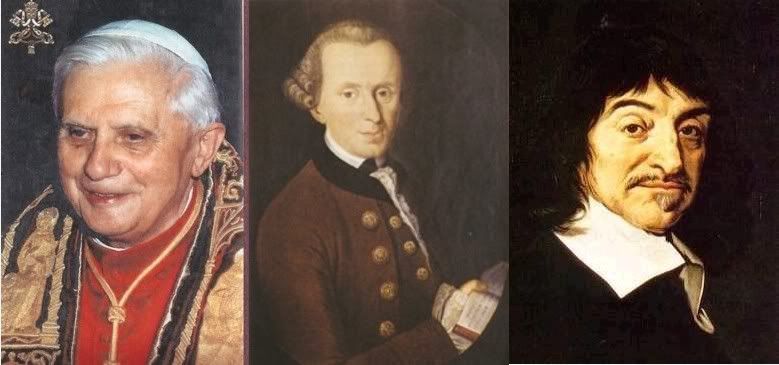
In his now infamous address in Regensburg, Pope Benedict XVI attempted “a critique of modern reason from within.” This critique is, ultimately, a critique of a naturalism, or scientism, which reduces the legitimate uses of reason to empirically verifiable truths. Benedict’s critique follows two lines, through which he attempts to show that modern reason is itself grounded in a fusion of Hellenism and Christianity, a fusion that cannot be repudiated either by the sciences or by theologians without an essential loss. First, he argues that science itself depends on a recognition of the world as rational, as subject to laws which human reason is capable of grasping. Scientific reason by itself cannot account for this correlation between the knower and the known; the grounding of scientific reason must, therefore, lie in a deeper and wider application of reason. In this regard Benedict invokes the Greek conception of logos and the Platonic tradition, which, ultimately, goes back to Parmenides' famous claim that thought and being are one. Second, and somewhat more obscurely, Benedict argues that the tradition of Western rationality also assumes a religious and an ethical ground, a ground that establishes a community, and which scientific reason overlooks at its peril. As Lee Harris nicely demonstrates, the reference to Islam and violence fits into this argument: Benedict’s goal is not to condemn Islam, but rather to insist that the rational community required as a backdrop for the sciences is a community grounded in an ethics and a faith that are fundamentally rational. If the West had not accepted reason over violence as a means of addressing conflicts, there could be no such thing as modern reason. Thus, insofar as modern reason cannot address faith and ethics, it denies the social conditions of its own possibility.
Benedict’s argument is confusing, in the first place because he does not clarify the relation between these two weaknesses of modern reason and, in the second, because his account may strike many philosophers as somewhat outdated. On the point of ethics, for example, Benedict claims that
the questions raised by religion and ethics, then have no place within the purview of collective reason as defined by "science", so understood, and must thus be relegated to the realm of the subjective. The subject then decides, on the basis of his experiences, what he considers tenable in matters of religion, and the subjective "conscience" becomes the sole arbiter of what is ethical.
The conflation of ethics and religion here is problematic; this conflation, I think, hurts Benedict’s cause more than it helps. But also, he paints a view of ethics that found its heyday in Logical Positivism and is now largely out of date in philosophy. At the same time, however, Benedict has a point. First, insofar as he is considering modern reason as a cultural, rather that simply academic philosophical, phenomenon, he may well be right in arguing that ethics is now seen as a subjective matter. Second, if we look at philosophical ethics, the major taxonomy by which moral philosophies are categorized remains, despite challenges, a division between cognitivism and non-cognitivism, a division that is itself based on questions of the relation of truth in ethics to truth in the sciences. That the sciences give us truth is presupposed; that ethics is capable of doing so is in question. In this sense, Benedict is certainly right—modern reason approaches ethics through the lens of the sciences, and reason is thereby prevented from reaching its full potential.
But it is also very odd that the main, or initial culprit in this move is, in Benedict’s picture, Immanuel Kant. The reason is that Kant narrowed the scope of what we can know to theoretical reason, and placed questions of ethics and religion in the domain of practical reason and outside of knowledge. Now, though this formulation does rest on a correct reading of Kant’s preface to the First Critique, there is now something of a consensus that in his more careful moments Kant distinguishes between knowledge (Wissen) and cognition (Erkenntnis), and that practical reason can give us the former, if not the latter (it is really the Kant-inspired Romantics, like Schleiermacher, who attempted to sever faith from reason). Furthermore, far from restricting the scope of reason to the physical sciences, Kant makes the practical into the genuine domain of reason. Truths about ethics and religion are, for Kant, given to us through reason and are therefore immune to empirical falsification. He was thus arguably the strongest supporter since the Greeks of the view that religion and morality are accessible to reason and must be evaluated on rational grounds. Moreover, on the other issue Benedict raises, that of the rationality of the empirical world as an assumption of modern reason, Kant did perhaps more than anyone before or since to build a foundation for this coherence of knowledge and the known.
I think the true transition to modern reason, as Benedict conceives it, occurs in Descartes. Famously, in laying out his approach in the “Discourse on Method,” Descartes suggests the following approach:
This method, of course, is carried out in the “Meditations,” where complete skepticism is used to clear the way for certain knowledge sanctioned by reason. But of course, as is well known, Descartes leaves something out of this doubt. While he is engaged in his doubt and reconstruction, he must still live in the company of others, he must still act, and therefore he must have principles on which to act. He thus resolvesas for the opinions which up to that time I had embraced, I thought that I could not do better than resolve at once to sweep them wholly away, that I might afterwards be in a position to admit either others more correct, or even perhaps the same when they had undergone the scrutiny of reason.
to obey the laws and customs of my country, adhering firmly to the faith in which, by the grace of God, I had been educated from my childhood and regulating my conduct in every other matter according to the most moderate opinions, and the farthest removed from extremes, which should happen to be adopted in practice with general consent of the most judicious of those among whom I might be living.This move—to doubt all received opinions except those of custom and faith—is described by Descartes as a matter of expediency or prudence. And in the “Meditations,” he begins upon the course of establishing his skepticism with the claim that “it is the part of prudence not to place absolute confidence in that by which we have even once been deceived.” Prudence, in other words, is not itself placed in doubt; instead, it is prudence that first occasions that doubt itself. We can then see three underlying issues occurring in Descartes’ analysis:
(1) Prudence is the assumption by which we ground the method of philosophy and which in turn motivates that method.
(2) Morality, at least in the form accepted by the community to which Descartes belongs, is assumed as a truth not to be questioned.
(3) Consequently, since the method of doubt involves clearing the ground of received opinions in order to find a rational foundation for true replacements for those opinions, the ground of morality cannot be found in this way, since morality was not placed in doubt as part of the method.
The result of this approach is that whatever grounds morality later receives in Descartes’ work are not moral grounds—they are grounds derived from the knowledge he reaches through the application of his method. There is a dual move involved here: morality, specifically as involving the customs of a community, is assumed in the investigation; by means of the same move, morality is later based on scientific grounds and is thus deprived of its own sphere of rational inquiry. It is therefore not surprising that modern reason, on Benedict’s account, largely limits itself to the sciences and simply assumes a moral community as its foundation: that, after all, was the starting point of the founder of modern philosophy.
Labels: philosophy