Monday, May 21, 2007

Evil and Akrasia in the Context of Authenticity

Davidson claimed to have been the first to separate the problem of weakness of will, or akrasia, from the moral context in which the problem is traditionally taken up. He is right to make this separation, though it is a separation that needs to be carried out consistently. Davidson’s interest is in separating out akrasia as a distinctive problem for philosophy of action. But it seems equally important from the standpoint of moral philosophy to separate the problem of akrasia from that of evil. Akrasia is not equivalent to evil, and here I want to suggest a way of distinguishing the two in a vaguely Heideggerian language.

Heidegger characterizes our being as a being thrown into the world into the midst of pre-given possibilities. Some of these possibilities we will live through; others we will bypass entirely. Some we will take up as authentic, as genuinely our own. Others we will see as foreign to our selfhood. Akrasia seems to me to involve acting on possibilities that we are living inauthentically, but which are opposed to other, authentic possibilities. For example: Let us say that I am a student and see studying as the authentic possibility of my life. Occasionally, instead of studying, I go out clubbing and drink until 5 in the morning instead of getting any work done. Let us say (there is obviously no necessity in this) that I do not see this partying as authentically my own. In other words, I see a certain kind of behavior as defining of my self, as genuinely mine, and yet I am capable of taking up a behavior that I see as foreign to who I am, to my self, and to my will. How is this possible? This, I take it, is a way of characterizing the akrasia problem.

But the problem of evil involves something different: it involves the question of how I might choose to act contrary to a law that I see as the law supremely binding on me. This law—and I am here using the Kantian model of morality—is a law that is genuinely my own insofar as I am a person. Sometimes I may be tempted to break this law, and I do so. It is, of course, possible that what is involved in my breaking the moral law is nothing but a weakness of the will; in cases of that kind we have to look for an explanation along the lines mentioned in the previous paragraph. But the more interesting question of evil is that of an evil that is specifically chosen as evil; that is, I am both aware of my obligation according to the moral law and of the fact that the choice I am making explicitly violates that law. Yet at the same time I make this choice, and do so not through any weakness, but in a fully intentional way.

The way to characterize the second problem, I think, is by seeing it as a conflict not between an authentic and an inauthentic possibility, but as a conflict between two authentic possibilities. Both the moral law and the incentive to deviate from it belong to my self. This seems like a correct characterization of moral conflict: the difficulty is not simply that I am not strong enough to act on my judgment of what is morally right, but that I myself have made the other incentive powerful enough to oppose the moral law. I have done this by making the incentive into an authentic possibility for me. Kant does sometimes imply that moral conflict boils down to a case of akrasia, which is why he defines virtue as the strength to resist non-moral incentives. But it is also clear that, for Kant, we are responsible for having chosen those non-moral incentives as powerful enough to need resisting. That the incentives opposed to the moral law are, in fact, incentives we have made our own is the pre-condition for a theory of virtue as strength.
Obviously this rough account is not sufficient to explain moral conflict: we will need, among other things, an explanation of why morality should be seen by us as authentic at all. My goal here was only to suggest a framework within which akrasia and evil can, I think fruitfully, be distinguished. Only by seeing evil as involving a choice in favor of a certain view of one’s own self, rather than a simple fleeing from the self-conception implied by the moral law, can we start to understand the sort of responsibility involved in a violation of morality.

Continue Reading...

Tuesday, May 15, 2007

Ought and Can: What Implies the Implication?

The foremost question posed by libertarians to compatibilists is how a thoroughgoing determinism can leave room for moral responsibility. Another significant question, however, is how it can leave room for moral obligation, and what sort of obligation would be implied. One way to approach this question is through Frankfurt's rejection of the principle of alternative possiblities (PAP) as an obstacle in the way of making responsibility compatible with determinism. As David Widerker notes (1), it remains an open question whether Frankfurt’s rejection of (PAP) requires “renouncing the Kantian thesis that ‘ought’ implies ‘can’, i.e.
(K) An agent S has a moral obligation to perform (not to perform) an act A only if S has it within his power to perform (not to perform) A.”
Whatever the virtues of this debate, it is actually very clear that Frankfurt cannot accept the Kantian thesis (though he claims he can) for the simple reason that (K) is very obviously not a correct representation of that thesis. No understanding of the English (or German) language, however charitable the interpretation, is sufficient to yield (K) as an accurate restatement of the claim that “ought” implies “can.” Instead, as the wording of the implication clearly implies, the thesis is:
(K1) If an agent S has a moral obligation to perform (not to perform) an act A, then S has it within his power to perform (not to perform) A.
Of course the two are logically equivalent, so that (K1) entails (K): if we can establish on independent grounds that S cannot perform (not perform) A, then we cannot reasonably say that S has an obligation to perform (not perform) A. For example, if there were a species of beings that were rational but literally could not avoid constantly and intentionally killing each other (so, only a little different from human beings), then they could not have an obligation not to kill each other. So doesn’t this just mean that (K1) really boils down to (K)? I don’t think so. A Kantian might question the coherence of any such thought experiment, and do so on the following Kantian grounds: to be under an obligation is to be a rational being for which reason is practical. But if reason is practical, then it follows that we are able to act on it. (K) and (K1) differ precisely in their emphasis: Kant is not trying to derive obligation from ability (an “ought” from an “is”), but to show that obligation has implications for how we must see ourselves; more specifically, for what abilities we must attribute to ourselves regardless of lack of any possible other evidence for them. This, obviously, is a very different project. Logical equivalency does not guarantee identity of meaning.

(K1) is intimately tied to a project of giving what may be seen as a libertarian spin to freedom: it is determined entirely on the basis of our obligations, and established despite the truth of determinism (which also makes it completely different from any libertarian theories around today that I am aware of). Thus we come to Frankfurt, who happens to be a compatibilist. As a compatibilist, he can accept (K). There is nothing incoherent about accepting both that (1) our abilities place limits on our obligations and (2) the extent of our abilities can be fully ascertained within the scope of the natural sciences (whether deterministic or not). But (K1) meshes only with (1); it implies—strictly implies—that (2) is at least possibly false. It follows that Frankfurt would have to reject (K1). Would he have to do it on the basis of his rejection of (PAP)? I don't see how, except insofar as his rejection of (PAP) comes with other compatibilist assumptions.
(1) “Frankfurt on ‘Ought implies Can’ and Alternative Possibilities” in Analysis, Vol. 51, No. 4. (Oct., 1991), p. 223.

Continue Reading...

Wednesday, May 9, 2007

Kant on Freedom and Evil

An argument still frequently raised against Kant’s theory of freedom goes as follows: Kant seems to have two conceptions of freedom, which may be termed, following Sidgwick, the rational and the neutral conception. According to the rational conception, freedom involves acting on the moral law. It is only when we act on the moral law, the idea goes, that we are actually free of the determination of our will by natural desires. Rational freedom, then, seems necessary in order to account for our ability to act morally. The neutral conception, on the other hand, involves our choosing between good and evil; that is, knowing the law, we choose to act on it or to willingly violate it. Without this conception of freedom it becomes impossible to blame agents for their immoral actions.

The standard criticism (formulated in some way or other by Reinhold, Sidgwick, and Prauss) is that these two conceptions clearly can’t work together: either we are only free when we follow the moral law, in which case we cannot freely choose to violate it and are never responsible for immoral actions, or we are always free, in which case there seems to be no internal connection between freedom and the moral law. Nelson Potter and, more recently, Henry Allison, among others, have pointed out in response that Kant actually defines freedom as the ability to follow the moral law, which means that one can be free without ever actually acting morally, so long as one is capable of acting morally. But the misunderstanding (and criticism) keep coming back, and to address them I want to look at a passage in the Metaphysics of Morals, where Kant deals explicitly with the problem (or at least as explicitly as he ever deals with the major problems) and suggest two important consequences of this passage.

The sentence in question reads:

die Freiheit nimmermehr darin gesetzt werden kann, daß das vernünftige Subjekt auch eine wider seine (gesetzgebende) Vernunft streitende Wahl treffen kann (6:226)
Roughly:

freedom can never be located in this, that the rational subject can also make a contentious choice against his (lawgiving) reason
If we keep in mind the context—Kant is talking about the definition of freedom—this isn’t a particularly strange claim. In fact, I want to insist that it is much closer to plain common sense than to the wacky metaphysics of which Kant is sometimes accused.

Here is the first point: Kant is talking about the rational subject acting against his reason. It makes sense that freedom—as an ability of the subject—cannot be defined in this way. Why? Consider an ordinary object, like a chair. We may roughly define a chair as an object for sitting on. The definition is perhaps incomplete, but it would be a very strange mistake to complete the definition by adding that it is also possible not to sit in a chair. It is of course true that there are chairs in the world in which no one is sitting at the moment, but that is not a good reason to define a chair as an object for sitting on or not sitting on. The first part belongs to the definition of a chair, while the second part belongs to a description of how chairs are sometimes actually used in practice and has nothing to do with the definition. By adding the second clause we do not simply confuse the definition of a chair, but we in fact ensure that we are not giving a definition of it at all. “An object for sitting on or not sitting on,” you see, would be a description that does not apply in any essential way to chairs: it would also cover tables, beds, floors, elephants, other people, etc. Similarly, it would be very odd to define the freedom of a rational subject as the subject’s ability to act in accord with or in opposition to its reason. To be rational means that one’s freedom lies in the exercise of that rationality, not its abandonment.

But now let’s look at the second point: In parenthesis, Kant puts the important word “lawgiving” before the word “reason.” Why is this important? Because it seems to refute the claim by some prominent analytic Kantians (see, for example, Korsgaard’s argument in “Skepticism About Practical Reason”) that immorality is just a species of irrationality. It is not. There is, of course, something irrational in violating one’s reason. But it is not as obvious that there is something similarly irrational in violating one’s lawgiving reason. Kant is, in other words, tipping his hat to Hume’s famous quip:
‘Tis not contrary to reason to prefer the destruction of the whole world to the scratching of my little finger. (Treatise of Human Nature, Bk. 2, 3, iii)
There is nothing contrary to reason in this. There is, however, something contrary to lawgiving reason. But this sort of contradiction is not a logical one: it is a contradiction between the standards set by reason, on one hand, and evil on the other.

Kant never denies that we can freely choose to act contrary to the moral law, and he does not claim that it is irrational to do so. This is implied by his account: if evil were nothing more than a species of irrationality, then we would not be responsible for our evil actions any more than we are responsible for an innocent mistake in multiplication. This raises a new difficulty, of course: how can we understand the freedom of a rational being as allowing for action contrary to lawgiving reason? I will not address the problem here. My goal has, rather, been to deal with two common misreadings by pointing out, first, that Kant’s definition of freedom in terms of the moral law does not, in fact, rule out the possibility of freely acting contrary to the law and, second, that action contrary to the law is nevertheless freely chosen and not simply an error of reasoning. The problems that remain with the conception of freedom, I believe, must thus be addressed through the problem of evil.

Continue Reading...

Monday, April 30, 2007

Is Phenomenology Moribund? (Part II)

Alright, I finally scrunched in some time between grading logic tests to continue my argument from the previous post.


It has been argued--no, not argued really, just asserted--that phenomenology is moribund. Or at least as moribund as logical positivism. Since I work on phenomenology, I am naturally chafed by this assertion. Take that for what it's worth. I admit that phenomenology suffers from some pretty serious deficiencies, especially in questions of method ("analytic philosophy," I might interject, is not immune to this either apparently). But I also think that there's a lot to be said for it, and that many of the charges lobbed at it don't stick.

In particular, I was in the middle of arguing that phenomenology ought to be ranked along with physicalism and computational functionalism as one of the three serious approaches to the philosophy of mind. Each of these approaches models itself off a more accepted, perhaps more respectable science. Physicalism is modeled off the natural sciences (especially biology), computational functionalism off of proof-logic, computer science, robotics and AI--and phenomenology off of mathematics.

I ended the previous post by claiming that the former two, while enjoying stricter and clearer methods, are not adequate to what the mind, most likely, is. Conversely, while phenomenology suffers from a vague and discombobulated method, it is more adequate to what the mind, most likely, is. So now to that case.

Why not physicalism? Physicalism is the thesis that mental states are just states of the central nervous system. In the most radical forms (Churchlands), it is the thesis that the predicates of folk psychology are archaic left-overs from the Iron Age that will slowly drop out as we learn to talk about the brain in more precise, scientific ways. But not all physicalisms need be so radical. What they all must share is the thesis that, ultimately, to be in some 'minded' state is to be in a specifiable physical state. No mental property of a world will differ from another without a corresponding physical difference. Or, for creatures with mental states, to be in the same physical state is simply to be the same.

It should be noted that physicalism so defined is compatible with most computational functionalisms, insofar as one can be both a computational functionalist and an intentional realist. Thus to further define the physicalist theory of mind in a way which precludes its compatibility with computational functionalism, we should add the following rider: a theory is physicalist iff, per minded creatures, to be in the same physical state is simply to be the same, and physical states are not consituent.

Let me explain what I mean by ‘constituent.’ Constituency is typified by propositional states. This means that the constituent states are complex, with ‘parts’ related and defined in systematic ways. Further, these parts are solely defined by these systematic roles. If physical states are constituent, then they are constituent in just the same way that propositions are constituent. This is what computational functionalists of the intentional realist variety argue. The problem is that it does not seem remotely plausible that any physical system, qua physical (this is the important clause), could instantiate the laws of constituency. Thus, as I will shortly argue, since thoughts (the contents of the mind) are necessarily constituent, this means that it is unlikely that brain science will ever be mind science. Hence, my argument: 1) thoughts are constituent; 2) the laws of constituency violate the laws of physics, and vice versa; 3) thus, a physicalism that denies constituency a fortiori denies thoughts; 4) but there are thoughts with constituent relations; 5) hence, physicalism is false.

This sort of argument is found in Sellars, in Quine and Davidson, also in Fodor. It is the problem that Frege, Husserl and Sellars have attacked under the various banners of classical empiricism, psychologism or associationism. The primary difficulty these latter suffer is logical. When modern day physicalism stopped talk about impressions and the stream of consciousness, reverting to neurons and dendrites and so on, it no doubt got rid of some rather metaphysically dubious entities, but doing so did not at all address the logical problem that was the real issue in the first place. That issue is this: the laws of logic do not conform to the laws of physics, and any system which obeys only physical laws will not be able to respect some of the more peculiar laws of logic. For instance, physical relations can only obtain between two actually existing entities or states of affairs, but not so in logic. Another question I’ve never found a good physicalist answer to: Let’s say that there is a physical instantiation in my brain of the belief: ‘Some Roses are red’. Where is the logically equivalent belief that ‘Some roses are not nonred’? Or ‘Some red things are roses’? Or ‘Some red things are not nonRoses’? Are these logical properties of that belief really there like its physical properties, such as mass, volume, density and charge? Similarly, what about the semantic relations this belief entails. If I believe that some roses are red, I also believe that some roses are colored, that something is red, that something is extended, that some plant is red, that something that my girlfriend finds endearing when given as an unsolicited gift is red, etc. Again, are these semantic features of the belief really there along with its physical features? And where is ‘there’? That ‘something is red’ cannot be a unique feature of this belief, because it would also be a feature of the belief that ‘Some stop signs are red.’ Are both of these specific beliefs related to the more general belief which is situated elsewhere, or is the more general belief merely there in both in the same way that two different objects can enjoy the same mass? All of this just strains my credulity. I don’t see how it can be right. Physicalists may have answers to these questions, and I would love to hear them, but I haven’t found them. Of course, most physicalists would argue that while the objects of propositional attitudes are constituently structured, the physical states themselves are not. But this just seems weird to me.

Why not computational functionalism? Computational functionalism to my mind sufficiently answers the logical problems that plague the physicalist. I consider it to be phenomenology’s real rival. My problems with computational functionalism are primarily of an epistemological and semantic sort, and these, it has to be admitted, are always less surely footed. Computational functionalism is, I take it, necessarily internalist and representationalist. And there are any number of reasons why neither of these epistemological and/or semantic positions is likely correct. Here are some reasons why: 1) Following Turing, computational functionalists must argue that mental states are discrete states; one is either in that state or one is not. So let’s take an example: there’s a loud bang, and I turn my head and both see and hear a car roar off. I come to the belief ‘That was a backfire.’ I haven’t the foggiest idea what a backfire is. I just know that it is a loud, gun-like bang some cars make and which emanates from tailpipes. My mechanic, on the other hand, can no doubt say quite a bit not only about what a backfire is, but about what caused it, how to prevent it, how different car models suffer from different likelihoods of backfire, etc. Consequently, when my mechanic comes to a belief, ‘That was a backfire,’ her belief is not the same as mine. Thus, according to computational functionalists like Fodor, we have in fact different beliefs. Fodor takes observations like this as evidence against holism. I take it as evidence against computational functionalism. It seems plausible to me that I and my mechanic have the same belief, only hers is more informed, and more variegated than mine. Husserl, who allows that fufillment and truth is a function of degrees and range, can allow and account for this; computational functionalists cannot. 2) According to computational functionalism, to be in a mental state is to be in a discrete internal state. The content of that state is internally determined. This is why computational functionalists have to be representationalists. This however restricts whatever can be said about the content of that state to whatever is actually there internally. Thus, mental representations (semantically contentful internal states) can only consist of entered data and the rules (ie ‘concepts’) for manipulating that data. But consider this (a sort of example found in Noë): you reach in to a black sack and feel something hard, smooth, with some variation in texture, shaped somewhat cylindrically. After a few moments, almost spontaneously, as it were, you realize that you are feeling a lighter. Husserlians want to argue that the content of that belief ‘Here’s a lighter,’ does not exist inside the skull, nor outside in the world; it is ideal; it does not exist at all. Not so computational functionalists. Presumably the moment of realization occurs when the restricted data that I am receiving tactilely is sufficiently processed up to the point where I (whatever that is!) realize that I should access the ‘lighter’ function and compute the relevant data accordingly. I don’t think this is wrong in its basics. The disagreement is whether we need this realization to be the running of the lighter function, or the actualization of an ideal content. The represtationalist answer runs into some pretty serious difficulties. What is the relation between the representation and the object? Does this representation obtain whether I realize it or not? Then how do I know what it does obtain? What is the relation between myself and this representation? The computational functionalist has to answer these questions. Husserl, on the other hand, does not, at least not anymore than the mathematician does. Finally, the computational functionalist qua representationalist has be committed, I believe, to the experiential plenum: all content is there all at once and in full to/as the mind. But this probably not correct. In the lighter example, phenomenologist qua content externalist can argue that the content of that experience is there through the particular real (reelle) parts of my experience (the smoothness, hardness, room-temperature-ness, etc) but only the latter are really experienced; the lighter as such, the lighter, which is the real content of my experience, is there as a whole, as it were, virtually. Husserl can make sense of this phenomenological fact; the computational functionalist cannot. Hence, the argument here boils down to the following: 1) externalist and reliabilist arguments about semantic, epistemological and experiential content are probably right; 2) computational functionalism, as internalist and representationalist, is incompatible with such externalism; 3) hence, computational functionalism is probably wrong.

Let me say that I can imagine how computational functionalists would respond to these objections, and they would be good responses--unlike the physicalists. So I in no sense pretend that this is knock-down. But I do not need a knock-down argument. I don’t necessarily want to argue that phenomenology is obviously better than these other two, only that it ought to be considered as a serious, if equal, rival.

So what is the phenomenologists’ answer? The contents of the mind are ideal, exhibiting ideal relations. The same is true of mathematics. The rules of the mind exist--if that word is appropriate at all--like the rules of chess exist. Husserl’s insight, I think, was to realize that the sorts of issues he was dealing with earlier in his career--namely, how is it that the rule-like manipulation of symbols, which no ‘intuitive’ understanding need accompany or underwrite, can nonetheless express true mathematical results?--applied to the range of mental states as such, and even further, to the range of ordinary, thoughtless ‘chit-chat’. This is the phenomenon that fascinated Husserl throughout his life; it is the one constant that perdures from the very beginning through the very end and through all the changes; it is, in a sense, the one question all of phenomenology is trying to answer. And it is, finally, simply a damn good question, one that ought to be more central in philosophy of mind, and one which, more than the others, phenomenology gives a good answer for.

In a final post, I will explain more fully what phenomenology is in its own terms, and also explain why some of the more indirect arguments for its moribund status are themselves, truth be told, moribund. Stay tuned.

Continue Reading...

Saturday, April 21, 2007

Davidson and the Causes of Action: A Problem of Permission

Philosophy of action has for decades focused on reasons; since Davidson, a good deal of debate has centered on the question of whether reasons are causes, whether those causes are occurrent or agential, and whether we can use reasons-explanations to replace causal explanations altogether in discussions of agency. My suspicion is that something is missing from the discussion. The focus on reasons comes from the conviction, first, that they provide us with the best way of explaining an action as something other than simply an event and, second, that it is by focusing on reasons (or, in a related branch of investigations, on endorsements of desires) that we bring out the role of the agent as deliberator. But is this dual approach sufficient to capture the notion of an agent? I suspect that it is not, and what is misleading in the standard account is that, by taking explanation and rational deliberation as its starting points, it fails to give adequate attention to the most basic aspect of action: it is often irrational and involves little or no deliberation.

Of course problems of irrationality—self-deception, akrasia, addiction—have taken a central place in analysis; but they are generally viewed as problematic in a secondary way: a theory of rational action is expected to account for them, but only against the backdrop of a pre-existing theory of rationality. The typical approach comes from the methodology of the sciences: first one formulates laws, then one goes on to explain away exceptions. Similarly, one first tries to come up with a generally rational explanation of action, then one attempts to explain away deviations from that rationality. But does this take matters in the order appropriate to a subject matter like action?

In his Dialectic of Duration, Gaston Bachelard takes on the orthodox view of Bergson, according to which time is fundamentally a continuity, which the intellect then breaks up artificially into a series of instants. Instead, Bachelard posits that in every field—action, psychology, science, poetry—it is the instant that is primary, with continuity being constructed in a secondary manner by the intellect. Thus, for example, memory involves particular moments that stand out—I remember waking up early, then a diploma being placed in my hand, meeting my roommate’s parents, and only then do I fill in the gaps between these events to evoke in memory a continuous commencement ceremony. Similarly in the domain of action: every action, for Bachelard, has at its central core the instant of permission. To act, I must give permission to do something. Whatever deliberation precedes the act, it is moot until I permit the performance of its dictates. Whatever consequences follow from my action—and whatever purposes are intended in it—are dependent ultimately on that instant. Thus, Bachelard opposes a phenomenology of the instant to that of duration, so that the continuity of action—its precursors and products—are dependent on the permission to act.

Davidson, I think, presents us with a similar scheme. In fact, it is the priority of the instant—or, in his case, the causal relation between reason and action—that allows explanation of action to be an explanation at all. But at the same time, Davidson conceals the cause by explaining the action as a bodily moment that is rationalized by a primary reason (a combination of a desire and a belief). The concealment is this: while the causation of an action by its corresponding reason explains the action, it explains it only because the action itself (along with its consequences) is explained by reference to its causal precursors. The emphasis on causality, so central to Davidson’s account, is only an explanatory feature that allows the past and future of the instant to be neatly brought together into a single whole. This creates a difficulty, and I think it is a difficulty that is internal to Davidson’s account: he cannot explain the very thing he is trying to explain.

To see this, let us take a look at Davidson’s view of freedom. His goal is not to reconcile freedom with determinism, but to show that freedom is a causal power. The central problem is that if the causal precursors of an action are themselves seen as actions—as something an agent does—then we are caught in an infinite regress because we must now account for the freedom of those prior actions. The way to resolve the problem is to posit precursors to the action that are not themselves something an agent does; they must be states or events that are not done in any sense, so that it makes no sense to even ask whether or not they are free. The solution, of course, is that an action is caused by reasons. The desires and beliefs that make up those reasons are states or events, but they are certainly not actions. Insofar as these reasons cause an agent to act, his action is intentional and free. And freedom, here, is a causal power because what makes the action free is precisely that it is caused by an agent’s reasons.

But I think Davidson cannot explain freedom as a causal power because he cannot explain the causality of reasons. He admits, essentially, that his account can only explain the causal precursors of an action provided that the action has already been carried out. Prior to this, there is no way to predict an action—that is, there is no way to derive the necessity of an action from its causal precursors (although statistical analysis can get us pretty close to this). Davidson’s major concern, then, is to show that something can be called a cause even in the absence of strict laws relating the cause to the effect. But what is lacking is any account of the agent’s role in this relation. If I act on my reasons, this involves an instant of permission—I do not just give myself a reason to act (as, say, Robert Kane’s analysis suggests), nor do I put an end to deliberation and let the final step in the deliberative process carry me to action (this is the overlooked Hobbesian account of action). Rather, I actively permit myself to act. It has seemed to many philosophers of action that if we start from this instantaneous act, we are stuck in an irrational and inexplicable kind of agent-causation. But I think that only holds so long as we emphasize the causality of the instant of “permission.” Instead, I am suggesting, the causal aspect does not underlie the instant of permission; rather, without the permission, we cannot explain causality at all.

Continue Reading...

Friday, April 20, 2007

Is Phenomenology Moribund? (Part I)


I think not. Here’s why.

I’ll start with a bold claim: there are only three defensible approaches to the philosophy of mind on the market today: physicalism, computational functionalism, and phenomenology. All three get something quite important right, while none of the three get it all right. You probably have no problem allowing for physicalism and functionalism. You might have a problem with phenomenology. Let me make a case.

First off, I grant that phenomenology is weakest in the area where both functionalism and physicalism are strongest: method. For obvious reasons, physicalism has the benefit of a method as strong as any in the natural sciences. Computational functionalism, for the same reason, has a method as strong as any devised in computer science and proof-logic. These are more or less standardized, more or less exact. One can tell, at least in a general way, when the method has been properly, and when improperly, applied. Phenomenology, alas, has nothing of the sort. Admittedly this is to the great frustration of phenomenologists and nonphenomenologists alike. We know that the phenomenological method involves operations like bracketing, describing, reflecting, reductions, and so on, but these concepts remain vague and just how they go together is, at this point, anyone’s guess. As a friend of mine once nicely put it, the danger with phenomenology is that there doesn’t yet seem to be any recognized criteria by which to police competing descriptions. I think that this is, unfortunately, basically right, and it is something to which serious phenomenologists need to be devoting more of their time.

To say that phenomenology, as yet, enjoys no defined method is only the most drastic way of putting things. Mitigating remarks should be added. More attention needs to be paid to the fact that phenomenology, while new as a specific science, is not a new sort of science. Phenomenology was supposed to be, at least initially, like mathematics. In my opinion, this is one of Husserl’s truly original contributions to philosophy in general and philosophy of mind in particular. So far as I can tell, while a few philosophers seemed to model their philosophy of mind on mathematics (Plato, Descartes, Leibniz), Husserl was probably first to make the modeling explicit. I think when put this way Husserl looks a little less fruity, and a little less wrong. Husserl’s proposal is that we study the contents of the mind similar to how we study numbers, fields, domains, topologies, etc.

Why is this proposal--that we approach the philosophy of mind like we approach mathematics--attractive? This proposal amounts to the claim that we can study the contents of the mind like we study numbers, planes, infinities, sets, and so on. Mathematicians study numbers, topologies, functions, sets, without any clear understanding or broad agreement as to what these things, really, are, or indeed, whether they are. And yet mathematics proceeds more or less on time and in fine fashion while remaining neutral about the ontological status of the objects it studies. In other words, what’s important in mathematics is that our knowledge of these objects is exact, clear and precise, not whether, how or where they are. If Husserl’s right, then we can treat the contents of the mind--Concept and Object, Truth and Proposition, Fact and Law, etc.--in like manner.

Of course, it may be the case that the ontological status of these objects does in fact turn out to influence the integrity of our knowledge about them, but again, this is just as much, and just as little, a problem for phenomenology as it is for mathematics. And no one accuses mathematics of being ‘moribund’ just because there is as yet no general and accepted agreement as to what that status might be. Phenomenology therefore is just as weak, and just as strong, as the science it is modeling itself after, and the same could be said respectively about physicalism and computational functionalism.

In the following post, I'll argue that in fact things stand even better for phenomenology than this. For only a science like mathematics--this will be the argument--could be adequate to the sorts of things mental contents are. Thus, while physicalism and computational functionalism may have more firmly established methods, unfortunately they are of the kind which are intrinsically inadequate to the sorts of objects they purport to study, viz., mental (or 'ideal') contents. And while phenomenology, I grant, as yet does not enjoy broad agreement or acceptance about just what its method ought to be, we do know enough to say that it is the sort of method which, if developed, at least would have a chance of working.

Continue Reading...

Sunday, April 15, 2007

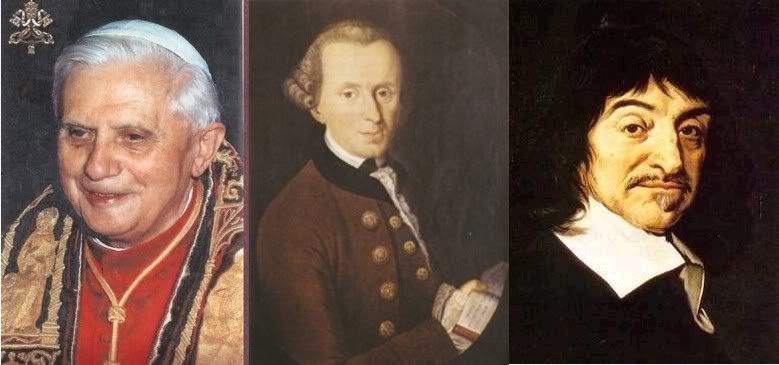
The Pope and the Cartesian Legacy


In his now infamous address in Regensburg, Pope Benedict XVI attempted “a critique of modern reason from within.” This critique is, ultimately, a critique of a naturalism, or scientism, which reduces the legitimate uses of reason to empirically verifiable truths. Benedict’s critique follows two lines, through which he attempts to show that modern reason is itself grounded in a fusion of Hellenism and Christianity, a fusion that cannot be repudiated either by the sciences or by theologians without an essential loss. First, he argues that science itself depends on a recognition of the world as rational, as subject to laws which human reason is capable of grasping. Scientific reason by itself cannot account for this correlation between the knower and the known; the grounding of scientific reason must, therefore, lie in a deeper and wider application of reason. In this regard Benedict invokes the Greek conception of logos and the Platonic tradition, which, ultimately, goes back to Parmenides' famous claim that thought and being are one. Second, and somewhat more obscurely, Benedict argues that the tradition of Western rationality also assumes a religious and an ethical ground, a ground that establishes a community, and which scientific reason overlooks at its peril. As Lee Harris nicely demonstrates, the reference to Islam and violence fits into this argument: Benedict’s goal is not to condemn Islam, but rather to insist that the rational community required as a backdrop for the sciences is a community grounded in an ethics and a faith that are fundamentally rational. If the West had not accepted reason over violence as a means of addressing conflicts, there could be no such thing as modern reason. Thus, insofar as modern reason cannot address faith and ethics, it denies the social conditions of its own possibility.

Benedict’s argument is confusing, in the first place because he does not clarify the relation between these two weaknesses of modern reason and, in the second, because his account may strike many philosophers as somewhat outdated. On the point of ethics, for example, Benedict claims that
the questions raised by religion and ethics, then have no place within the purview of collective reason as defined by "science", so understood, and must thus be relegated to the realm of the subjective. The subject then decides, on the basis of his experiences, what he considers tenable in matters of religion, and the subjective "conscience" becomes the sole arbiter of what is ethical.

The conflation of ethics and religion here is problematic; this conflation, I think, hurts Benedict’s cause more than it helps. But also, he paints a view of ethics that found its heyday in Logical Positivism and is now largely out of date in philosophy. At the same time, however, Benedict has a point. First, insofar as he is considering modern reason as a cultural, rather that simply academic philosophical, phenomenon, he may well be right in arguing that ethics is now seen as a subjective matter. Second, if we look at philosophical ethics, the major taxonomy by which moral philosophies are categorized remains, despite challenges, a division between cognitivism and non-cognitivism, a division that is itself based on questions of the relation of truth in ethics to truth in the sciences. That the sciences give us truth is presupposed; that ethics is capable of doing so is in question. In this sense, Benedict is certainly right—modern reason approaches ethics through the lens of the sciences, and reason is thereby prevented from reaching its full potential.

But it is also very odd that the main, or initial culprit in this move is, in Benedict’s picture, Immanuel Kant. The reason is that Kant narrowed the scope of what we can know to theoretical reason, and placed questions of ethics and religion in the domain of practical reason and outside of knowledge. Now, though this formulation does rest on a correct reading of Kant’s preface to the First Critique, there is now something of a consensus that in his more careful moments Kant distinguishes between knowledge (Wissen) and cognition (Erkenntnis), and that practical reason can give us the former, if not the latter (it is really the Kant-inspired Romantics, like Schleiermacher, who attempted to sever faith from reason). Furthermore, far from restricting the scope of reason to the physical sciences, Kant makes the practical into the genuine domain of reason. Truths about ethics and religion are, for Kant, given to us through reason and are therefore immune to empirical falsification. He was thus arguably the strongest supporter since the Greeks of the view that religion and morality are accessible to reason and must be evaluated on rational grounds. Moreover, on the other issue Benedict raises, that of the rationality of the empirical world as an assumption of modern reason, Kant did perhaps more than anyone before or since to build a foundation for this coherence of knowledge and the known.

I think the true transition to modern reason, as Benedict conceives it, occurs in Descartes. Famously, in laying out his approach in the “Discourse on Method,” Descartes suggests the following approach:

as for the opinions which up to that time I had embraced, I thought that I could not do better than resolve at once to sweep them wholly away, that I might afterwards be in a position to admit either others more correct, or even perhaps the same when they had undergone the scrutiny of reason.

This method, of course, is carried out in the “Meditations,” where complete skepticism is used to clear the way for certain knowledge sanctioned by reason. But of course, as is well known, Descartes leaves something out of this doubt. While he is engaged in his doubt and reconstruction, he must still live in the company of others, he must still act, and therefore he must have principles on which to act. He thus resolves
to obey the laws and customs of my country, adhering firmly to the faith in which, by the grace of God, I had been educated from my childhood and regulating my conduct in every other matter according to the most moderate opinions, and the farthest removed from extremes, which should happen to be adopted in practice with general consent of the most judicious of those among whom I might be living.
This move—to doubt all received opinions except those of custom and faith—is described by Descartes as a matter of expediency or prudence. And in the “Meditations,” he begins upon the course of establishing his skepticism with the claim that “it is the part of prudence not to place absolute confidence in that by which we have even once been deceived.” Prudence, in other words, is not itself placed in doubt; instead, it is prudence that first occasions that doubt itself. We can then see three underlying issues occurring in Descartes’ analysis:

(1) Prudence is the assumption by which we ground the method of philosophy and which in turn motivates that method.

(2) Morality, at least in the form accepted by the community to which Descartes belongs, is assumed as a truth not to be questioned.

(3) Consequently, since the method of doubt involves clearing the ground of received opinions in order to find a rational foundation for true replacements for those opinions, the ground of morality cannot be found in this way, since morality was not placed in doubt as part of the method.

The result of this approach is that whatever grounds morality later receives in Descartes’ work are not moral grounds—they are grounds derived from the knowledge he reaches through the application of his method. There is a dual move involved here: morality, specifically as involving the customs of a community, is assumed in the investigation; by means of the same move, morality is later based on scientific grounds and is thus deprived of its own sphere of rational inquiry. It is therefore not surprising that modern reason, on Benedict’s account, largely limits itself to the sciences and simply assumes a moral community as its foundation: that, after all, was the starting point of the founder of modern philosophy.

Continue Reading...

Thursday, March 15, 2007

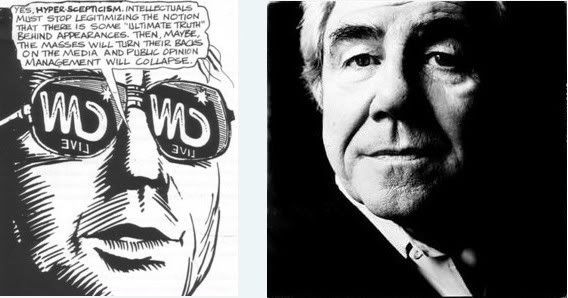
Was Baudrillard a Charlatan?


When the Guardian ran a recent article on the death of Jean Baudrillard, a mass of comments followed in its wake. Some were full of absurd adoration, others were equally absurd in their dismissals. I would like to respond to my favorite comment; it is my favorite not because I think a single word of it is right, but because I am impressed by how wrong someone can be. Here are some highlights:

He was an intellectual charlatan. The basic idea that everything is a simulacrum was robustly refuted by the Anglo Saxon tradition in philosophy. It is either dishonest, or if seriously meant, false.
Baudrillard, along with Barthes, Derrida, Foucault etc, illustrates the key weakness of the French intellectual left: their refusal to acknowledge human reality…
All this has its roots in a view that we cannot know what we plainly do know - and could not get through ordinary life without knowing. In the view that what is real is in fact illusory, that what is valuable is of no importance. It is a short step from the view that nothing can be said that is not about the person saying it, to the view that nothing that is done to people or populations has any meaning other than as an expression of feeling by those doing it, and about which nothing meaningful can be said since it too will just be an expression of an equally valid but different feeling…
Any focus on human life as it is lived and felt in the real world that for Baudrillard was a simulacrum would get you out of this immoral and dishonest approach to life on the planet.
The antidote to this idiotic nonsense is GE Moore. You say you believe time is unreal. Are you really saying I cannot say whether I shaved before I ate breakfast? You say you believe the external world is unreal. Do you really mean I am not looking at a chair right now? You say you believe there is no such thing as right and wrong. Do you really mean....?

There are so many ironic turns here, that it is hard to decide where to begin. The commentator mistakenly seems to place Baudrillard in the category of philosophical skepticism of the Cartesian variety, and thinks that this has been “robustly refuted” by Anglo-Saxon philosophy (at least, I think he is suggesting that skepticism has been refuted, since that was a concern of Moore, and as far as I know no analytic philosopher has dealt with the notion of reality as a simulacrum). But what could it mean to say that skepticism has been refuted? Skepticism is not the view that there is nothing real or that there is no external world; skepticism merely doubts the existence of an external world. The only way to refute doubt is to prove that the object of that doubt really exists; but since any such proof is likely to be furnished by the real world, there is no reason not to doubt the proof. Moore’s argument, in fact, was to hold up his hands, point out that they exist, and use this as proof that the external world exists. I have always been impressed by Moore’s argument, though largely just because I’m generally impressed by arguments that completely miss the point, and Moore’s is the best illustration I’ve seen of this in the history. What skepticism requires is not a counter-proof, but a response to the doubt itself, a way of showing the origin of the doubt and drawing the consequence that the doubt is unwarranted. To the best of my knowledge, the best approach along these lines is taken by Heidegger in Being and Time.

Next, the commentator accuses Baudrillard, along with much of the Continental tradition, of taking a view of morality that grounds it exclusively on feeling. But I am not aware of any continental philosopher holding that view. The idea that morality is nothing but the expression of a speaker’s emotions was, in fact, never taken seriously as a philosophical doctrine until A. J. Ayer. The special irony, of course, is that for logical positivists the view that morality is just an expression of emotion arises directly out of the view that only the physical world is real; that it is, in fact, the only reality. But Baudrillard never rejects morality; rather, he gives us an analysis of a world in which such things don’t matter, or in which “nothing that is done to people or populations has any meaning” other than as a media spectacle. Perhaps that is too extreme a characterization of our world, and Baudrillard is unquestionably guilty of hyperbole. But if our world is dangerously close to being a world in which all moral considerations, all the horrors of war, are concealed by Hollywood-esque montages on the news, then the best way of affirming the importance of morality may well be to diagnose the social malady that threatens to conceal this importance. This is what Baudrillard tried to do. Perhaps he was not always right, perhaps he was too provocative for his own good, and perhaps he lacked the philosophical depth needed to tackle these problems. But how many Anglo-Saxon philosophers have really made that effort?

But it is also a mistake to see Baudrillard as a philosopher. He is by training a sociologist. And he is something else: a philosophically informed public intellectual, that is, a species so rare in the Anglo-American world that we have trouble recognizing them when we see them. This isn’t to say that nobody tries: plenty of philosophers have political blogs (such as this one), but these tend to vacillate between academic philosophy and political commentary on a level not far removed from that of many other political blogs. Baudrillard tried to do something else: he tried to diagnose the social framework that we inhabit, within which our political and moral decisions take place.

But let us briefly turn to Baurdillard’s most provocative thesis: that reality has been replaced by the simulacrum. First off, again, this is clearly not a version of skepticism: Baudrillard it not doubting reality; rather, he is pointing out that we now experience reality through a media veil; for us, reality is simulated. This idea is both catchy and seemingly insane; when I first read Simulations as an undergrad, I would go outside and stand in the snow, feeling the snowflakes melt on my cheeks, feeling cold wind blowing through me—this, I told myself, was no simulation, it was reality at its strongest. But take something like love. Love, we might think, is the epitome of real human feeling. But in what sense is the obsession with love, my obsession, our cultural obsession, genuine? Where do we pick up the idea that love is the most important human feeling, that without it no life can be complete? From movies, maybe, and from the lyrics to every other song that’s come out in the past 50 years. Benjamin worried that mechanical reproduction would destroy the aura of the work of art; instead, it has perhaps made the works more precious, given them a greater aura. It seems to have done so for emotions. It is not only art works that can be mechanically reproduced; human emotions are just as easy to put on a screen and transmit. In other words, the argument that reality is “real,” and not a simulacrum is a tricky one—which of our feelings, of our perceptions, of our habitual ways of thinking are really “real”? In a way, the point is almost meaningless—of course human feelings, perceptions and thoughts are shaped by their environment; that has always been true, and it has not made these things “less real.” But what if the forces that shape us now are concerned only with more excitement, with sensationalism, with providing an entertaining spectacle? Does that make a difference? Does that somehow corrupt reality, turn it into something else? That was the question that concerned Baudrillard.

Continue Reading...

Would Husserl Believe in Qualia?

Recently I’ve been trying to work out what Husserl might have thought about qualia. Since I work on Husserl, and since I'm congenitally put off by the notion of qualia, I’ve been trying hard to convince myself that Husserl would also have rejected the idea. I’m now pretty sure that this is right. Here’s one part of my overall case.

There are three reasons why people--both specialists and nonspecialists in Husserl--assume that Husserl was (or would have been) a believer in qualia: his commitments to 1) the irreducibility of consciousness; 2) the immanence of intentional states; and 3) the presence of nonrepresentational content--usually referred to by Husserl as ‘hyletic data’--in experience. I limit my remarks to the third reason because it is the most likely to be of interest to nonHusserlians.

Most defenders of qualia define a quale as a nonrepresentational feature intrinsic to experience and accessible to introspection. Husserl’s (early) notion of hyle seems to fall under this category. From the beginning Husserl rejected the notion that sensations (either of the Humean, or of the Moorean/Russellian sort) were primary objects of intentional consciousness. This was an essential consequence of Brentano’s discovery of intentionality: the objects of our experience go beyond those experiences themselves. (Phenomenologists refer to this as the ‘transcendence’ of intentional consciousness; it is one reason why no analysis of the actual contents or parts of a mental state, either in terms of phenomenal content--eg red patches, high tones, rough feels--or physical states--eg neural states--will ever get at the contents conscious states are conscious of--a special method is needed for that, namely phenomenology). Hence, sensations might be essential means by which I am aware of perceptual objects, but they are not themselves the objects of which I am aware. Still, in Husserl’s early theory (primarily in Logical Investigations), raw sense-data are interpreted through intentional, objectivating acts as presenting perceptual objects. This picture is broadly Kantian. When we analyze any given experience, we find that there is an intuitional, or sensory component, and then a conceptual framework which, when applied to that sensory content, ‘animates’ that content into the representation of an object. Hence, such sensory content is not by itself representational. Yet when we reflect upon our experiences the presence of such nonrepresentational content is evident. Thus, there seem to be for Husserl nonrepresentational features intrinsic to every experience and evident to introspection. Husserl calls this stuff hyle, but it seems very much like what is now referred to as qualia.

Now, qualia theories of all sorts are committed to the following proposition: there can be a change in the sensory or phenomenal features of an experience without there being any change in the representational content of that experience. For instance, as I stare at a tomato, the particular red hue of the tomato might alter some, and though this alteration is a change in my experience, I am still seeing the same tomato, Thus, despite changes in the sensory components of my experience the representational content of that experience has not changed. I suspect that when fully fleshed out, even Husserl’s earlier theory would not support this claim. That is to say, even given Husserl’s concept of hyle, I suspect that changes in hyletic data would for Husserl always signal corresponding changes, however trite, in the representational content of that experience. But this exegetical claim is not one I am interested in defending here, and that is because Husserl ends up rejecting this picture altogether and for good reason.

In Husserl’s later theories he replaces the concept of hyletic data with the concept of affective unities. Affective unities are so called because they are passive unities, aspects of an experience not constituted by ‘spontaneous’ acts. (This distinction may seem troublesome to some, but really, it is more or less just how McDowell and Sellars understand the difference between perception and judgment). Husserl began to make this switch around the time that he began to concentrate seriously on the phenomenology of time consciousness. Obviously I am not willing to go over that entire development here, though suffice it to note that an upshot of that analysis is the rejection of even the notional coherence of a discrete, isolatable, self-contained ‘now’ point; all temporal consciousness (and hence, all perceptual consciousness) essentially involves a dynamic field of retentions and protentions by means of which consciousness of the present is constituted. But if there is no discrete now, there is also no discrete sense-datum (because there is no discreteness period). Second, he argues that these affective unities are kinaesthetically (or ‘enactively’) realized. A battery of stimuli to the sense organs does not constitute perceptual experience. Perceiving the environment rather is knowing how to navigate within the environment in response to changes in that environment, and knowing what changes to expect. ‘Knowing’ in this case is obviously a sort of know-how, and can still be considered ‘passive’ only in the sense that no conscious judgments need be involved.

Back to Qualia: If the notion of affective unities in perception is coherent and correct, they make appeals to brute sense-qualities of experience (the blueness of the ocean, the sting of a needle prick) pretty incoherent. There simply is no brute, raw sense data (and hence, nothing that it is like to have such sense experiences). The kinaesthetic theory of perception, on the other hand, manages to get what one wants from a qualia theory without the qualia. Despite their mysticism, qualia theories do get right that there is an important difference between the appearing of an object and the object that appears. They then try to explain this difference by distinguishing between the representational content of an experience (the object that appears) and its phenomenal qualities (the appearing of the object). But consider this same distsinction from within the kinaesthetic framework: modes of presentation (the appearing of an object) are a function of one’s relation to the object. A coffee can appears rectangular from a direct horizontal angle, then appears circular as I raise my gaze to over top of it. As I move, I am only conscious of the same coffee can, and I do not suppose that it mysteriously morphs from rectangular to circular. This is because (to borrow a notion from Alva Noë) my experiences do not only represent objects, but they also represent my relations to objects, where I am--bodily--in respect to the object in the environment. These relations, let me iterate, are real; they really exist, and my experience really presents them. Thus, being presentational, even the features of an experience which are not part of its representational factual content are still representational. And this obviously contradicts the fundamental proposition of qualia theory: for while a change in my relative position towards an object would change the sensory content of that experience without changing the representational content, it will most certainly (by definition) affect the presentational content of my relation to that object. Thus, the kinaesthetic theory does not have any room for a change in sensory content not amounting to a change in representational content. Thus, it would be wrong to interpret the appearing of the object as opposed to the object which appears as describing qualia.

I realize of course that I have hardly made any arguments in defense of these views. But that was not my point. My point rather was only to make the case that Husserl, especially in his later works, develops a notion of experience which has no place for qualia. IF Husserl does indeed develop in the direction I claim, and IF indeed the theory in this direction both gets rid of qualia while managing to explain the single meager thing qualia theory gets right, then I have made my case. That's all.

Continue Reading...

Wednesday, March 14, 2007

A Naturalist Free Will?

I have been wondering about the goals, advantages, and limits of naturalism. Although for the most part philosophers seem to have dropped crude physical reductionism, naturalism in one form or another continues to occupy a dominant place. I suppose that the major appeal of naturalism is that by sticking to it, one avoids looking like a lunatic; after all, what could be more obvious than that the sciences give us hard truths? These may, of course, be revisable, but it seems ridiculous to suggest that we can ignore empirical evidence and come up with “facts” about reality from the comfort of an armchair (to be honest, I find couches much more comfortable, but those seem to have been reserved by psychoanalysts or, at least, their patients; philosophers in similar predicaments are supposed to use fly-bottles, and let me tell you, those are just not soft enough).

On the other hand, however, naturalism can threaten to reduce philosophy to bad science—that is, if philosophers start to focus primarily on formulating all philosophical theses in ways that open them to possible empirical verification, then strictly speaking there is no more philosophy; there is only a set of hypotheses which, presumably, science will one day be able to check out in order to resolve the problem once and for all. I am not saying that this shouldn’t be one of the things it may be worthwhile for philosophers to pursue, but any thoroughgoing naturalism seems to me to run into the standard Kantian problem: If science alone is the arbiter of truth, then what arbitrates the claim that science is the arbiter of truth? There are different ways of answering this question, but for obvious conceptual reasons, science simply cannot be self-legitimating. Thus, to take science as the ultimate—and sole—arbiter of truth is really to miss something about the facts as we know them, specifically that science is a human enterprise, linked to human projects and modes of reasoning that at some level cannot themselves be open to complete scientific analysis without begging the question.

If rejecting naturalism seems a bit ridiculous, accepting it in certain philosophical contexts can have far stranger consequences. Let’s take as an example the way philosophers commonly deal with free will, which strikes me as a non-naturalistic concept par excellence. One strong trend has been to do everything conceivable to avoid reaching that most horrible and utterly unscientific conclusion of noumenal causation, proposed by Kant. Even those who, like Davidson, want to say that not all meaningful discourse is reducible to physical description, still want to avoid a stance that veers too far from naturalism of some sort. Davidson’s anomalous monism is designed only to suggest how we might meaningfully talk about psychological causality without reducing it to physical causality. This is an important and interesting approach in its own right, but I am not convinced that it helps if one wants to develop a theory of libertarian freedom. Kant, after all, believed that psychological causality, even if it is not reducible to physical causality, still belongs to the domain of determinism because psychological states are phenomena; they are empirical entities, and are subject to the same law-like behavior as all other empirical entities (for Kant, this is the condition stipulated by the Second Analogy).

Of course it is possible that Kant was wrong in his insistence that all phenomena are subject to causal law, and that is in fact the position most commonly taken by incompatibilists: if we have libertarian freedom, then determinism must be false as van Inwagen argued. To accommodate naturalism, then, libertarians have gone to great lengths to devise a concept of agency that fits into a view of the rest of the world as we know it through science. For example, there is the theory of agent causation, i.e., that agents somehow are the causes of their own action. Or there is the attempt to argue that decisions are completely uncaused by prior events, and this is accompanied by a desperate appeal to quantum indeterminacy, which will hopefully somehow match up to our deliberative processes. Perhaps the most desperate, while also the most brilliant and innovative attempt is to hold on to some version of strong determinism but insist that it allows for
backward causation—all physical events are caused by previous physical events, but our choices are capable of affecting the entire causal chain, future and past.

This desperation brings out what I think is one of the great advantages of naturalism in philosophy: by trying to squeeze themselves into a bottle, philosophers are forced to come up with increasingly ingenious approaches. But is it wise to be limited to this bottle in the first place? Are these attempts to explain free will really so much more reasonable than the proposal of noumenal causation? Why can’t we postulate a second discourse, irreducible to scientific discourse and yet still meaningful by other criteria? To be sure, it is probably wise to avoid claims that clearly oppose scientific data, and that very loose criterion of naturalism seems perfectly sound. But a properly formulated non-naturalist discourse would be a sort of discourse that could not, in principle, conflict with scientific conclusions. The attempt to formulate such a discourse was the point of Kant’s transcendental idealism, and it was carried over into the various projects of phenomenology. Why, then, should we dismiss the notion of a discourse that was, in a sense, tailor made to account both for free will and for the possibility of scientific cognition?

Continue Reading...