Friday, October 26, 2007

Sartre the Womanizer (II): Lying, Ethics, and the Freedom of Others

Apologies for the long blogging hiatus. There was a cancellation of my internet access, followed by a traumatic return from Germany back to the land from which my accent (and spelling) originates, another conference paper, job applications, etc. But now I’m back—blogging is the best stress relief. In the last post I tried to sketch out a problem with a completely unlimited conception of freedom: particularly, that freedom tends to undermine itself. People who freely choose to lie and to put themselves into situations where they feel compelled to lie end up with a nasty habit of lying. Here I want to take up the ethical aspect of lying by looking at what lying has to do with the freedom of others.

Let’s try a continuation of the imaginary conversation with Sartre started in the last post. First, here’s an objection that could be raised to Sartre’s approach:

T: But doesn’t lying to people undermine their freedom, their ability to make decisions about their lives, by depriving them of somewhat crucial facts—in this instance—about their relationships?

If, as Sartre often insists, he is committed to the freedom of others, then this really does seem to be a problem for him. Of course there are really two senses of freedom in operation. First, there is the freedom that we all have at all times just by virtue of being for-itselves rather than in-itselves. It would not make much sense to be committed to the freedom of others in this sense, since every person is already, by definition, free in this sense (though one can be committed to the authentic exercise of freedom by others; more on this below). The other kind of freedom, which I will call voluntariness to distinguish it from the first kind, is freedom from external constraints. Some of these constraints are political, and removing those was an important project for Sartre. Other constraints are matters of knowledge, particularly of the circumstances relevant to one’s exercise of freedom in the first sense.

Recall that Aristotle, in the Nichomachean Ethics, includes certain kinds of ignorance in the list of circumstances that reduce an agent’s culpability and voluntariness. If I give my friend a piece of string without knowing that he plans to use it to make a detonator, then my action of aiding in a terrorist ploy can hardly be considered voluntary. In the rather extreme case where I am completely ignorant of all the circumstances relevant to understanding my actions—if, for example, I am in some delusional state—then none of my actions are voluntary. I may still be free, in the sense that facticity does not necessitate my actions, but my freedom is completely worthless since I have no genuine control over what I am doing; only an ability to originate my actions. Lying to others about circumstances relevant to their decisions obviously deprives them of knowledge they would need to maximize the voluntariness of their actions. Consequently, lying to others decreases the value of their freedom. This can hardly be a good thing.

But perhaps Sartre can deny that his lying has such dire consequences:

S: Their freedom is not undermined at all! They choose to believe my lies!

That is, when we lie, we lie to a person, a for-itself, who is free to take our words any way she sees fit. The responsibility for the decrease in the other’s freedom is thus conveniently transferred from the liar to the silly person who falls for the lie. This can happen in two different ways. First, the other person does not have to believe what the liar tells them. They can exercise a general skepticism about anything they are told. Or, perhaps, the women should pay more attention to how Sartre acts and less to what he says. If they simply accept his lies at face value, they are being naïve. The fault is entirely their own.

Second, they might recognize that Sartre is lying, but deceive themselves about this fact, pretending that the lie is true. When Sartre lies to a woman he is seeing with the goal of getting her to stay with him, doesn’t she simply choose to believe him because, even though he is lying, she really wants to stay with him and needs an excuse to do so? If she chooses to believe him, she does so in bad faith. The fault, again, is her own.

But clearly neither of these tactics gets the liar off the hook. The reason is simple: presumably, Sartre does not lie to women because he is pathological; he does it because he wants them to overlook his infidelities and trust in his commitment. A non-pathological lie—that is, a lie told in order to attain some goal—has its acceptance as part of that goal. One does not, normally, lie unless one intends the lie to be accepted. The other’s acceptance of the lie aids in the attainment of some goal. But this just means that the liar, in lying, is already committed to the other’s bad faith. The liar aims at a conflict—a war of freedoms. He pits his freedom against the freedom of the other, his authenticity against the other’s inauthenticity. (The exercise of one’s freedom against the freedom of others is brilliantly attacked in Camus’s Caligula, possibly his best work.)

Regardless, then, of whether Sartre intends that the women believe him because they are naïve or because they want to believe him, in lying he commits himself to their bad faith. One simply cannot systematically lie to others while claiming to be committed to their freedom—either the authenticity or the value of their exercise of freedom is undermined. The ethics of the liar cannot be an ethics of freedom—at most, it can be an ethics of personal freedom, but it assaults the freedom of others.

Taking this together with the last post, my suggestion is that there cannot be a Sartrean ethics of freedom. What Sartre’s major influences—Kant, Hegel, and Heidegger—all recognized is that freedom cannot be a freedom of indifference. A freedom without internal norms is self-defeating, because in various ways it undermines both one’s own freedom and that of others. My own feeling is that Sartre’s mistake lies in understanding freedom primarily with regard to the particular rather than the universal. That will have to wait for another post.

Addendum: Fido's comments raise a point that I should throw in with the post. It is a point about whether freedom can tolerate internal norms. I think it has to, though it cannot tolerate external norms. This ties in with a further question: Could Sartre simply bite the bullet and drop ethics altogether? It seems like it is possible to just say, "Well, okay, I must be committed to my own freedom, to my own authenticity, but not that of others. That would be nice, but it isn't necessary." But I don't think so. A commitment to freedom involves a commitment to everyone's freedom. This is an internal norm. If I did not have this commitment, then I would be placing a limit on freedom—I would be concerned with freedom only as limited by my own person. And this would be an external norm. In any case, though, even a truncated Sartrean account cannot do entirely without internal norms: our freedom commits us to acting in the full awareness of that freedom, i.e., to authenticity.

Continue Reading...

Monday, September 17, 2007

Maturity, Enlightenment, and Liberalism

Somewhere between the time of Kant’s ‘Was ist Aufklärung?’ and today, something happened to the link between liberalism and enlightenment. I’m not quite sure what this was, but I’m not too happy with it. Here is my best estimation.

Let me be upfront about my position. I do not consider myself to be a liberal. I am sensitive to critiques of liberalism leveled by feminism, certain versions of Marxism, critical theory and post-modernism. That said, I am not anti-liberal. Frankly, I don’t know how to label myself, mainly because I have to admit that in the end, I have no coherent set of political beliefs or attitudes. Take that for what it’s worth.

But I do get frustrated with liberals. Mainly this is because I think that they often fail to make as strong a case for their own position as they should. Moreover, I think that they misunderstand their own theory. As someone who does no work professionally in the field of political philosophy, this is probably a stupid claim to make. So be it. At the very least, I am quite sure that non-academic liberals mis-represent what is best about their own position.

There is a certain story told about the meaning and theory of liberalism that finds expression in Berlin’s essay on the two freedoms. Given the complexity of human life, especially in modern, variegated societies, any commensurability between conflicting conceptions of the good is highly unlikely. We are wise, therefore, to cease striving for such commensurability and instead work towards constructing rule-sets and procedures that allow different individuals amassed in a single society to pursue each their own conception of the good so long as interference with others pursuing their own projects is kept at the absolute minimum commensurate with the maintenance of society.

This finds idea finds its most systematic and sophisticated expression in Rawl’s theory of justice. Rawlsian liberalism is defined by a neutral framework for arbitration consistent with a base level of a redistributive welfare state. Conflicting agents resort to the adjudicative powers of the state in the case of noncriminal conflict. Criminal conduct is defined as conduct that violates the rules-set of this framework. For instance, the state allows me to open a large Walmart franchise that puts your papa’s small frame-shop out of business, but it penalizes me if my Walmart pollutes the local water supply. Justice defined by compliance with accepted rule-sets is said to be procedural, rather than substantive.

Rawlsian liberalism pretends that it does not promote any particular vision or understanding of the good life over any other. It promotes tolerance and choice, but these are supposed to be abstract principles requisite for following the rules, and therefore are not values particular to any particular or parochial vision of the good life. This of course has opened Rawlsian liberalism to communitarian and similarly argued critiques to the effect that in fact liberalism does promote particular, parochial visions of the good, despite its pretensions otherwise.

These charges are of course correct. Liberalism is not in fact neutral as to how individuals ought to conduct and understand their lives. But this is not necessarily a problem. My own reading is that liberalism, especially in the Anglophone countries, took its own rhetoric about proceduralism and neutrality too seriously. It adheres to neutrality to the point of performative contradiction. It has also convinced itself—without, it might be said, much argument—that promoting some version of what Berlin called ‘positive freedom’ will ineluctably, and despite the best of intentions, lead to authoritarianism, totalitarianism, and eventually, to some sort of nasty Gulag.

One reason for this development in liberal thinking was the loss of any obvious connection between liberalism and enlightenment. I would advise liberals to reclaim this connection.

Of course, there is some lip-service to enlightenment and progress in some liberal circles, but it is as an historical, societal predicate. Modern liberal societies are ‘enlightened’ or ‘progressive,’ but individuals are not. I would oppose this view to the Kantian, more continental versions of liberalism. For Kant, ‘enlightenment’, appled only in a derivative sense to societies as a whole. At bottom and essentially it was an individual predicate. Enlightenment is:

“the exiting of individuals from their self-imposed immaturity. Immaturity is the inability to use one’s understanding without the assistance of another. Immaturity is self-imposed when the cause is not any lack in understanding, but in lacking the decision and courage to use it without the assistance of another”

In other words, enlightenment is a positive value and a criterion for distinguishing good people from not so good people. A liberal of Kant’s kind escapes hypocrisy by denying neutrality: one should be tolerant, one should respect autonomy, and one should strive for intellectual maturity--and if one does this, one is a better person, on the whole.

A liberalism at the helm of enlightenment would not be embarrassed by this idea. It would for instance proudly argue that anyone emerging from the American education system should no longer believe that homosexuality is wrong or a perversion or unnatural; nor would anyone any longer believe that the earth is 6000 years old; but nor would anyone simply accept what an anthropologist or sociobiologist told them were the scientific pronouncements about human morality and community; science, like all other human accomplishments, would have to meet the bar of ‘self understanding.’ It would have self-conscious and assertive goal of producing citizens who sought self-consciously a place and role for themselves in society, and who could, hopefully, articulate why they were pursuing that goal. Liberalism in this Kantian, enlightenment sense would be based around a definite positive good, the good of maturity.

Continue Reading...

The Problem with Moral Psychology


Anyone could write this post, and what I’m going to say is nothing new to any student of philosophy, but it is for all that an important point and a little repetition can’t hurt.

I’m talking about this article, which enlists some of the current insights of moral psychology into the cause of urging civility upon the ‘New Atheists.’ Moral psychology—as far as I can tell—is the study of people’s moral motivations and understandings. The author—Johnahtan Haidt—argues that the field has changed dramatically over the past twenty years. Previously the discipline had been dominated by Kohlberg and Gilligan, both of whom placed the focus of moral psychology on overt or conscious reasoning processes—for Kohlberg, reasoning about justice and fair treatment, for Gilligan, deliberating about care. Now, however, moral psychologists are much more likely to investigate the motivations behind our moral behavior by looking at the brain, at our evolutionary prehistory, and at our evolutionary cousins.

Haidt summarizes the results of this change with four principles: first, intuition precedes cognition. Most of our decisions and beliefs are made in an affective flash, which overt deliberation then justifies post hoc. Hence, the reasons people verbalize as being the motivations for their actions, decisions or beliefs are mostly just the detritus of nonconscious processes. Second, moral thinking is not Truth- or Right-Tracking, but rather has the purpose of social doing, and has survived because it is socially useful. Third, moral thinking functions to define and preserve group identity, and hence collective action. Finally, moral thinking is about more than justice (Kohlberg; Kant) and harm (Gilligan; Mill), but is about also at least loyalty, authority, and purity.

So far, so good. I have no problem with any of this; in fact, I find interdisciplinary adventurism, when done with sophistication and conscientiously, completely commendable.

But then there are passages like this--from someone who ought to know better:

“[The new approach focuses] on the emotive centers of the brain as biological adaptations. Wilson even said that these emotive centers give us moral intuitions, which the moral philosophers then justify while pretending that they are intuiting truths that are independent of the contingencies of our evolved minds.”

Or again: “Josh Greene has a paper in press where he uses neuroscientific evidence to reinterpret Kantian deontological philosophy as a sophisticated post-hoc justification of our gut feelings about rights and respect for other individuals.”

Or: “Greene used fMRI to show that emotional responses in the brain, not abstract principles of philosophy, explain why people think various forms of the "trolley problem" (in which you have to choose between killing one person or letting five die) are morally different.”

Passages like these—with clauses impugning moral philosophers as mere ‘pretenders,’ as outdated and nonscientific, as too abstract—are not necessary. They suggest a belief that moral psychology, rather than complementing moral philosophy, is about to replace it. And that is just silly.

Let me make some obvious points. First off, moral philosophers are not just ‘pretending’ that moral truths are independent of the contingency of our evolved minds. There is good reason to think that they are so, just like every other sort of truth. No doubt humans have a tendency to anthropmorphize, and when this results in thinking that the weather is really out to get you, you are making a mistake. But to reduce all of our moral intuitions and theories to irrelevant expiations of our psychological hang-ups is surely just as much of a mistake. Humans are amazing creatures, and the fact that we can construct theories about not only nature but about how we ought to treat one another is a feature that deserves serious scientific investigation. But this fact gets us nowhere in deciding whether these theories are in fact true or not.

Secondly, there are many reasons to be suspicious of Kant’s moral philosophy, but to dismiss it as ‘a sophisticated post hoc justification of our gut feelings’ is certainly not one of them. By this reasoning, Einstein’s relativity theory could be read as ‘sophisticated post hoc justification’ of his ‘gut reaction’ against the stifling atmosphere of Viennean academic physics. This might even be true, but it is hardly of any importance to relativity theory. Just so for Kant.

Finally, ‘why’ people think and act the way they do can be answered in any number of ways, and to think that moral psychology has discovered the ‘true’ why is not only wildly plausible, but wrong. Socrates realized this more than two thousand years ago when he realized that, in a certain sense, ‘why’ he was in jail about to be executed was because of his flesh and bones, but according to another ‘why,’ these flesh and bones were absolutely irrelevant. This is among the oldest and most-tried distinctions in all of philosophy, and it has stuck around so long I presume because it is probably correct. And of course it is likely that we have certain phylogenetically inbred moral tendencies, or at least psychological tendencies that inform our moral deliberations and theories. But this is much like we have more of a tendency to group dots together when they are arranged vertically rather than horizontally, or we have tendency to see the two lines of the Müller-Lyon illusion as being of unequal length. But what does any of this have to do with morality? To make the analogy, certainly the Müller-Lyon illusion has a lot to suggest about how we happen to perceive the world, but it has nothing to say about whether the two lines are in fact equal or not. Similarly, moral psychology might have a lot to say about why there is a tendency to override our attitudes towards justice when dealing with strangers or foreigners, but it has little or nothing to say about how we ought to treat foreigners.

Oh, in case you are still wondering what any of this has to do with the new atheists: Haidt argues that the ‘new atheists’—Richard Dawkins, Sam Harris, Daniel Dennett and Christopher Hitchens—while decrying the atavistic and violent behaviors and passions that religious belief both underwrites and perpetuates, in fact display the same sort of Pleistocene moral sentiments and strategies that everyone else, including the religious among us, exhibit. Haidt is surely right about this, but I’m not sure what the point is: is Haidt arguing that Harris, Dawkins, and company are really sort of religious after all? Or is he just pointing out the obvious, which is that they rely upon the same neurological and anthropological architecture as that which underlies their ostensible opponents? Hence, because of this, there really is no difference between the two positions? The failure of Haidt I think to say anything of substance, really, in this debate is just one illustration about the failure of moral psychology in general to say anything substantive about morality itself.

Continue Reading...

Thursday, August 23, 2007

Sartre the Womanizer (I): Habit, Character, and Self-Deception

I hope in an upcoming post to throw out some thoughts about the relation between a philosopher’s life and thought, and in what ways we might reasonably connect the two. For now, I want to take Sartre as a test case. Recently, I watched a BBC documentary about him. These documentaries have, by their popular nature, a tendency to reduce thought to a mere response to particular life circumstances. In Sartre’s case, however, something interesting happened: the documentary stressed transcendence. Thus, while attributing Sartre’s rather extreme views on human relationships to his experience of being ugly, the documentary also emphasized his freedom in his attempt to work out a coherent political project through both his interest in Marxism and his later repudiation of it. But it was the brief discussion of Sartre’s tendency to sleep around that struck me. Olivier Todd recounted the following story (which, apparently, he has recounted quite frequently, both in conversation and in writing):

I remember asking Sartre, “how do you manage with all these women in your life?” And he would say, “well, I lie to them,” with this gesture of his arm. And I then said, “To all of them?” “Yes, to all of them.” “Even to Beaver?” “Especially to Beaver!”

This is interesting for any number of reasons; in the present context, because it does not strike me as a particularly strange thing for Sartre to say given his views of freedom. Unlike some features of a thinker’s biography, which may indeed be largely irrelevant to philosophy, this one seems to me to be a great example of the Sartrean notion of freedom in practice. Taking it as a sort of philosophical experiment, we can find here a kind of reductio of absolute freedom. Let’s work out a line in the form of an imaginary continuation of the dialogue:

T: How can you justify lying to all of them?
S: I can lie or not lie. What matters is that I choose to lie or not to lie, and that I make that choice in full awareness of the dreadful burden of my freedom.
Given the various positions laid out in “The Flies” (Orestes’ justification for murdering his mother and the king), Being and Nothingness, and “Existentialism is a Humanism” (especially the discussion of Flaubert), I think this is rather close to what Sartre would say. I am guessing, really, that this was how he rationalized his womanizing to himself. But there are two obvious difficulties here. The first has to do with the character of the liar and the problem of habit. The second (which will be the topic of my next post) having to do with the freedom of others.

A tradition stretching from Aristotle to van Inwagen is rather firm on the way habituation works: by choosing to lie, I take upon myself not only the responsibility for this choice, but also for the future consequences it has on my character, which every vicious choice corrupts. Sartre might have little patience for such views, since it is always possible for us to transcend the corruptions of our character. To think that my choices shape my character in ways that determine my future choices is to fall into bad faith, to take myself as facticity rather than transcendence. But this is a typical flaw in Sartre: the stark contrast between facticity and transcendence tends to miss the grey area between the voluntary and the involuntary (a flaw emphasized by Merleau-Ponty and Ricoeur). In his obsession with our ability to transcend our facticity, Sartre misses the phenomenological features of character such as temptation, rationalization, and, in general, everything that falls under the Kantian rubric of radical evil: having a capacity to be free is no guarantee that we will fully exercise that freedom. Our choices shape who we are and, because (as Sartre admits) self-deception is inevitable, our choices can strengthen that self-deception and undermine our exercise of freedom. It is precisely for this reason, one might say, that an ethic based on freedom must pay careful attention to that which—with or without our consent—undermines that freedom.

That we are free—in the Sartrean sense—does not, in other words, mean that all ethical determinations are ones we freely choose. We can see why by looking at two points. (1) First, Sartre does think that our radical freedom implies that we have a certain kind of obligation toward fostering that freedom—that is, there is an imperative to make decisions in the recognition of our freedom. (2) Sartre would reject the claim that lying is essentially a vicious act—if I freely choose to lie and freely commit myself to this choice, I affirm it as an ethical act. The problem, as I have tried to point out, is that contra (2), lying (despite being warranted in some circumstances) is vicious in its essence precisely because it undermines our ability to act in the full recognition of our freedom (1). Because we are beings capable of self-deception, and so beings that do not always act in full recognition of our freedom, we have an obligation—insofar as recognition of freedom is demanded of us—to avoid freely choosing whatever undermines this recognition. If the exercise of our freedom in full awareness is a value demanded of us by our freedom, then other hierarchies of value necessarily spring from it. Freely choosing lying is an unethical act precisely because—even if chosen in the recognition of our freedom and with the proper assumption of responsibility—it is an act that undermines our freedom.

Continue Reading...

Monday, August 20, 2007

The Philosophical Conservatism of Post-Modernism (Cont'd)

If, like us, you're interested and have nothing better to do, Roman and I continue on the theme of conservatism and post-modernism along with our friends at Now-Times. You can check out the blathering here.

Continue Reading...

Sunday, August 19, 2007

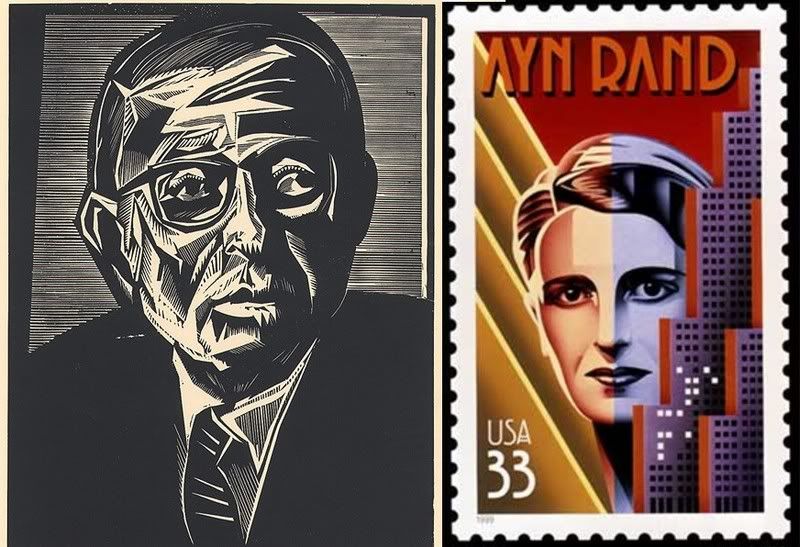
Sartre and Ayn Rand Would Have Had Some Weird Children


I am planning a slightly more involved post on Sartre for tomorrow, but I wanted to preface it with a question that has plagued me for some time. Are Sartre and Ayn Rand just cultural variations on a theme?

As a disclaimer, let me point out that I think Sartre’s nifty. Also, reading Sartre was one of the factors that pushed me from being interested in philosophy to wanting to study it professionally (I know I shouldn’t admit things like this publicly, but in my defense: I was 16 at the time). And I still think that, in many ways, Being and Nothingness is a genuinely great work of philosophy: it was one of the very few major works that aimed not just at resolving abstract metaphysical problems, but very sharply followed that ancient dictum of philosophy: Know Thyself. Sartre’s account of self-deception and the numerous permutations of it worked out throughout the book serve me well to this day in analyzing both myself and other people.

My feelings for Ayn Rand are a bit less warm. I read The Fountainhead when I was 17 (in order to enter the essay contest) and tried to follow up by reading some of her theoretical work; fortunately, I’d already read enough real philosophy by then to find her pretty laughable. I still think The Fountainhead is, overall, a good novel despite being seriously undermined by the attempts to get a “message” across (though Sinclair Lewis’s Arrowsmith is a more realistic and overall superior attempt at something similar: for one thing, it’s peopled by real characters rather than thinly disguised social virtues and vices). But really, I pretty much think Rand is a joke. Sartre, on the other hand, isn’t. And his tireless political commitment, though occasionally misguided, is impressive. So, what’s the connection?

What they share, really, is a similar delusion, or perhaps a similar lie: that they are conveying an uncomfortable truth when, in fact, they are telling the people exactly what the people want to hear. Let’s look at Rand’s case. The harsh truths she tells her American audience go something like this: Capitalism is wonderful. The world is objectively real. The highest value is individuality. Individuality consists of never collaborating with others, as that would water down the uniqueness of this individuality. And, naturally, morality requires that we care only about our own happiness and self-interest. Yup, integrity means looking out for number one. Obviously this is earth-shattering stuff.

Sartre is a better writer (though he also has a tendency to undermine the plausibility and readability of his fiction by overly un-subtle philosophical messages), and a much better philosopher, but this is to be expected: the French public is simply more demanding of its intellectuals. But what seems a bit disingenuous are his remarks about the “dreadful burden” of our freedom. He is telling a public that has just emerged from an occupation (in which many were complicit), a public that no longer trusts the old values, that, hey, it’s ok: the old values are only right if you choose them. And you’ve got the power to break free. All you have to do is recognize it! Sure, Sartre was accused of corrupting the youth and preaching despair, and I suppose his philosophy would’ve been more troubling if he were not preaching to the choir. But in that case, he wouldn’t have become the wildly popular figure that he was, and nobody would’ve cared what he was preaching. And yes, as I will discuss in my next post, there really is a troubling, dreadful element in Sartre’s view of freedom; whether he saw what it was, however, is questionable.

Lastly, both made the argument that one particular value (the individual’s life for Rand, freedom for Sartre) was the highest of values, since without it no other values are possible. Unless I’m missing something, both arguments commit the same fallacy of thinking that a necessary condition for the existence of values both (1) necessarily has value in itself, and (2) is of more fundamental value than any of the values that follow from it. (And yes, all of this is just a teeny bit caricatured. This isn't one of my serious posts. You probably guessed that from the title.)

So while I will go on reading Sartre, slipping him occasionally into papers, and having late-night debates about him over beer, while ignoring Rand and making fun of her followers, I just can’t help wondering if they were cast from a similar mold. All this, of course, pertains not so much to similarities in their philosophies, but similarities in what made them famous. But we can be a little more serious tomorrow...

Continue Reading...

Wednesday, August 15, 2007

Ends of Thought – Live in Europe!

The many regular readers of this blog who desperately need an excuse to go somewhere beautiful and close to the beach on September 7-9 can now rejoice: both of us will be presenting papers at SEFA 5, the Fifth Conference of the Spanish Society for Analytic Philosophy, in Barcelona (the conference is actually huge, so it features something exciting for almost everyone). In case just the thought of seeing how pretty and brilliant we are in person isn’t enough motivation to impulsively buy a ticket, I thought I’d shamelessly drop our abstracts for added appeal:

Michael Sigrist:

Does Empiricism Require Experience?
I critique the attempt, primarily in the work of Quine and Sellars, to establish an empiricism that dispenses with any necessary reference to experience. I define ‘experience’ as mental episodes (sensations, perceptions and cognitions) characterized essentially by a first-person, subjective point of view. I will refer to this understanding of experience as ‘phenomenological.’ Quine’s use of ‘stimulus meanings’ and Sellars’ psychological nominalism—to take just two examples—are precisely formulated to bypass any notion of ‘experience’ as just defined. I argue that such attempts are both falsely construed and falsely motivated. They are misconstrued in that the phenomenology of experience, though often underplayed, in fact performs an indispensable function both in Quine’s method of radical translation and in Sellars’ myth of Jones. They are falsely motivated in that allowing a phenomenological notion of experience back into their methods is not nearly so troubling for their respective empiricisms as Quine and Sellars seemed to fear. The result is a broadly Quinean or Sellarsian empiricism that nonetheless is able to accommodate the phenomenology of experience.

Roman Altshuler:

Freedom in the Ontology of Agency: A Reformulation and Defense of Korsgaard’s Argument

Christine Korsgaard has argued that in order to act for a reason, we must act on general self-chosen principles and, further, that acting on such principles and essentially creating our selves by identifying with them is a necessary condition for our being able to see ourselves as selves or agents. This view has struck many as unconvincing, and the standard libertarian objections are helpfully summarized by John Searle. He insists that Korsgaard conflates epistemic and ontological conditions of selfhood, that her argument makes it impossible to account for our ability to freely act capriciously, and finally that we cannot create our selves by identifying with general principles because a self is already presupposed in the adoption of those principles. I argue that we can best reconstruct Korsgaard’s account by accepting the first objection and focusing on the ontology of agency along Kantian lines while dropping the epistemological aspect. On this account an agent is defined not as someone necessarily committed to acting on principle, but as a being that is capable of acting on principles, since the ability to identify with at least some ends is clearly a necessary condition for being an agent. This modified account can address the problems of capricious action and the self presupposed in agency better than the libertarian view. Furthermore, by bringing freedom directly into the ontology of self-constitution rather than attaching it to agents as a property, this account combines the strengths of both libertarian and compatibilist approaches without their typical weaknesses.

Continue Reading...

Tuesday, August 14, 2007

The Philosophical Conservatism of Post-Modernism

I may be wrong, but I sense that philosophical post-modernism--the sort of philosophy that twenty years ago, perhaps, seemed like it might have rooted itself as a viable, vibrant alternative to the Anglo-Austrian engine (and that certainly had ambitions to do so)—is dead. As someone who likes and appreciates this tradition, and who feels even that it has been unfairly demeaned, I am upset at this. But it is hard, for instance, not to notice that there is no one right now working who can credibly be said to have picked up the baton left after the death of the generation of Derrida, Foucault, Levinas and Deleuze. I struggle to name a single work produced in the last decade that matches these thinkers at their best, and come up with none. The movement, so far as I can tell, is spent.

As I reflect on how or why this has occurred, I am struck by the suspicion that, despite its pretensions, philosophical post-modernism remained in a very fundamental and profound way conservative. This is not a novel thesis. It has been suggested already by Habermas. But Habermas had in mind a quasi- if not overtly political conservatism. I am referring instead to a philosophical conservatism.

This is evident in two ways. The first, a fixation on the subject, and the second, a mis-understanding about what was truly radical in the linguistic turn.

Despite it’s being displaced and de-centered, despite renouncing its sovereignty, and despite its subordination to the body and to affect, the subject never truly ceased being the focus of post-modern philosophical attention—or even obsession. Like the suppressed primal fantasy, the subject always returns.

By taking the subject seriously, the Heideggerian critique of presence seemed to have something intensely important, and epochal, to say. Similarly, the Derridean prognosis of the always already impossible achievement of this critique seemed equally profound and disturbing. This leant definition, and momentousness, to the ‘overcoming of metaphysics.’ But ignore the subject, and suddenly these projects seem pointless, if not silly.

And ignoring the subject is precisely what their counterparts across the Atlantic were doing. In this respect, Quine is far more radical than any of his continental peers. For Quine, rather than undermine, critique or work-through the subject, just breezily passed it by.

Secondly, post-modern philosophy simply misunderstood the linguistic turn by failing to notice that the important emphasis was on speech-acts, rather than symbols per se. Thus, in Deleuze, Derrida, Foucault, and their followers, we have what is, in effect, simply an updated Humeanism that takes symbols or the ‘text,’, rather than impressions, as the origin of the world, the mind and the self. Vastly over-estimating the importance of Saussure, while ignoring Austin, Wittgenstein, Quine and others, it seemed as if structuralism fronted a formidable thesis, and that the critique of structuralism was an essential endeavor. And this allowed it to seem plausible that the aforesaid ‘world,’ ‘mind’ and ‘self’ ( or subject, ego, author, etc.) were just a play of symbols and signifiers, much like for Hume they were just a play of impressions.

But again, for their trans-Atlantic peers, emphasizing the speech act placed the sentence, or statement, at the foundation of meaning. This move allowed the Anglophone philosophers to bypass what had been a major troubling theme throughout all of post-Kantian and post-modern philosophy, viz., how to make sense of a transcendental, world-constituting ego that at the same time is a part of that same world. Derrida thought it was crucial to point out that, in light of this problem, the possibility of pure presence was undermined by its own conditions of possibility. Deleuze and Foucault made similar points. But by turning to speech-acts, to pragmatics and so on, the importance of presence as relevant to truth, knowledge or being loses its sense. Thus Quine can say, without much trouble or contradiction, that a certain indeterminacy is endemic to all world-referring semantic items, and while interesting and important, this is hardly in some deep, metaphysical or epochal sense profound. In other words, the critique of presence can only appear to be an important project if, conservatively, you take Cartesian certainty as still somehow philosophically relevant. The move to speech-acts simply doesn’t.

In both of these respects, post-modern philosophy is still working within the modern tradition of Descartes and Hume in a way that simply does not apply to the major figures and trends of the Anglophone world.

A final note: while the movement is dead, I do not think that this means that the parts are dead. Like all great works, they are monadic. Heidegger, Foucault, even Deleuze, may all individually re-emerg in new contexts with new life. But the movement connecting these, so I surmise, is spent. The history of philosophy is full of such resurrections. Descartes, Spinoza, Plato, Kant, Hegel, Marx, are in constant cycles of reincarnation, and I see no reason why the same fate might not follow Heidegger, Foucault and company.

Continue Reading...

Sunday, August 12, 2007

Deliberation, Alternatives, and Thought Experiments

Since I've been reading some free-will stuff for a while now, the prevalence of thought experiments there has been bugging me. Here I want to take on one such experiment. Frankfurt examples have received a great deal of attention in philosophy of action in the continuing controversy over the question of whether moral responsibility requires having alternative possibilities. Dana Nelkin modifies these examples in order to make a different, though related, point: that in order to deliberate about a course of action, we need not believe that we are capable of doing otherwise. The example she sets up is as follows:

Imagine that you know that a brilliant scientist has the ability to fiddle with your brain in a way that causes you to act as she wishes you to. You know that she wants you to vote for Gore over Bush in the upcoming presidential race, and that if you do not decide to vote as she wishes, she will cause you to vote that way. So, for instance, you know that if you were to prepare to vote for Bush or otherwise fail to decide to vote for Gore, the brilliant scientist would cause you to vote for Gore. It seems to me that you could still evaluate the reasons for voting for each candidate and decide to vote for Gore on the basis of those reasons. (1)

This seems reasonable: even if I believe that I do not have a choice, ultimately, about which way I will end up voting, I can still make a responsible decision to take the only path open to me. So what, if not a belief that alternatives are genuinely open for me, is needed for deliberation? To approach this question, Nelkin constructs another thought experiment: it is virtually identical to the first one, except that now I believe that the brilliant scientist will force me to vote for Gore regardless of what I decide to do: even if I were to choose to vote for Gore, she would ensure that I do so by fiddling with my brain anyway. In this revised case, Nelkin admits, perhaps no real deliberation is possible at all. But if deliberation is possible in the original case but not in the revised case, the difference cannot be one of whether or not I believe there to be alternatives to my action, since I lack alternatives in both situations. Rather, the belief we need to have in order to deliberate is the belief that the deliberation can be causally efficacious. In the first case, then, deliberation makes sense because my decision to vote for Gore can cause me to do so, whereas in the second case it cannot.

But, despite an immediate intuitive appeal, do we need to accept the conclusions drawn from the first voting case, or does the thought experiment manipulate us into assenting to the conclusion? Let’s construct another case:
I need to go meet my friend, but my legs are tired from dancing all night. Walking sounds very unappealing. On the other hand, my arms feel just fine, and so I consider flying to meet my friend instead of walking. After some thought, I decide to walk after all (perhaps because flying takes up too much energy, and I cannot afford the amount of food I would need to replenish it; also, I fear the ecological consequences of spreading my deodorant throughout the lower atmosphere).
It seems to me highly implausible that anything like deliberation can take place here. Someone who genuinely deliberates about whether to walk or fly across town has to be a nut. What, however, distinguishes this flying case from the original voting case? In both situations I believe that there is only one thing I can do, but I am still able to decide to do it based on deliberation. It is only that, for some reason, in the flying case it does not seem like I can genuinely deliberate, whereas in the voting case it does. I think the difference lies precisely in our ability, while considering the thought experiment, to place ourselves in the position of the agent involved. I can easily imagine myself in the flying example and immediately see that deliberation in this situation would make no sense, since I already believe that I cannot fly. But to put myself into the voting example, I need to somehow fully convince myself that, really, a scientist can fiddle with my brain and force me to vote a certain way and that this really will happen. The problem for Nelkin’s argument, I think, is this: if I were to fully convince myself of that, then the intuition that deliberation is possible in this case would vanish. Her reading of this thought experiment seems to remain plausible largely because it is notoriously difficult to genuinely convince oneself of a counterfactual.

Nelkin addresses the possible objection to her view which claims that individuals who undertake deliberation while believing that they do not have alternative possibilities are really manifesting contradictory beliefs. She insists that the burden of proof must then fall not on her, but on the critic who wants to assign contradictory beliefs to otherwise rational agents. But I believe that the burden of proof still rests on her to show that genuine deliberation is possible without a belief in alternative possibilities. The plausibility of her intuition that one can deliberate within the voting case, it seems to me, rests precisely on our attempt to take up contradictory beliefs: both the belief that evil scientists do not manipulate our brains, and the counterfactual belief that in this one case they might. Since we—standing outside the actual voting case but only attempting to project ourselves into it—cannot make ourselves take up these contradictory beliefs, the possibility of deliberation within the thought experiment seems possible to us only because we have failed—without noticing—to accept the setup of the experiment.

(1) Dana K. Nelkin, “The Sense of Freedom” in Campbell, O’Rourke, Shier, eds., Freedom and Determinism (MIT: 2004)

Continue Reading...

Monday, August 6, 2007

Why Did the Consequence Argument Have Consequences?

There is an issue that has confused me for some time, ever since I first encountered, on The Garden of Forking Paths blog, the claim that the Consequence Argument (CA), as formulated by Peter van Inwagen, changed the landscape of the free will debate. I have since seen this claim repeated in print in several places, and the basic take seems to be this: before the CA was well known, most philosophers were compatibilists about free will. The CA, by formally showing the difficulties present in compatibilism, led to the resurgence of incompatibilist attempts to work out the free will problem. Since I first saw this claim, however, I have yet to figure out how, exactly, the CA argument could have been such a watershed in the free will debate. I do not mean here to criticize van Inwagen, but only to express my puzzlement. The puzzlement, essentially, comes down to this: what is it about the CA that could change the mind of anyone at all who already had a view on the free will problem?

I will not present the entire formalized version of the CA (nor will I try to outline all three versions of it), but here is, in simplified (though I hope not false) form, one version:

Def: P0 is a proposition that defines the complete physical state of the universe before the existence of any human beings, and P1 defines the complete physical state of the universe at any point after P0.

Def: Determinism is the thesis that P0, together with the laws of nature, necessarily entails P1. (That is, every physical state of the universe follows necessarily from any prior state, according to the laws of nature.)
No one has or ever had any choice about P0 or about the laws of nature.
Therefore, no one has or ever had any choice about any physical state of the universe, P1, whatsoever.
It follows that we cannot have any choice about our actions (which are physical events), since these all follow strictly from a prior state of the universe according to the laws of nature.
There are some problematic premises in the argument (and almost all of them have been questioned by someone or other), but essentially it seems to me to simply express, in one formalized version, the problem of free will and determinism. But since both compatibilism and incompatibilism are responses to that problem, I can’t see how someone could have been a compatibilist or an incompatibilist before learning of CA. That is, the argument seems to me to simply formalize just the issue that the very problem is about; anyone who has a take on the issue must, then, already have some sense of what the issue is. But then, why would a formalized version of the problem change someone’s mind?

Furthermore, I don’t see why this argument could have presented any real problems for classical compatibilist arguments; or, at least, I can’t see how it could have presented any problems that classical compatibilists were not already aware of and had not already tried to deal with. Here are at least two fairly obvious resources for dealing with it:

(1) It may well be true that nobody has any choice about past events and yet has a choice about their own actions, even if determinism is true. The past of P0 happened without the involvement of any agents. The actions of agents, on the other hand, have choices as constitutive features of those actions. The occurrence of an action in some propositions P1 then depends on the occurrence of a choice in a way that nothing in P0 does.

(2) Actions are events of a particular type. Following Davidson, we could say that actions are events that admit of a description under which they are intentional. An action, then, is an event that, on some description, has a particular kind of cause: a reason. But one can hold that reasons are not reducible to physical events. Thus, any action that occurs (will occur/has occurred) may be “inevitable” given P0 and the laws of nature. But the action is still up to the agent, since otherwise it would not be an action at all. That is, if an event is describable as following necessarily from P0 and the laws of nature, but it is not describable as following from a reason, then it is not an action. But no theory of free will that I am aware of insists that we must have a choice about events that are not actions.

Now both of these arguments may well have fatal flaws. What I don’t see, however, is how CA exacerbates those flaws, since the arguments, which predate van Inwagen’s formulation of CA, are already responses to the very problem CA formalizes. So what I cannot see is why someone who thought compatibilism was a good idea before they were aware of CA might think it was a bad idea after becoming aware of CA.

Continue Reading...